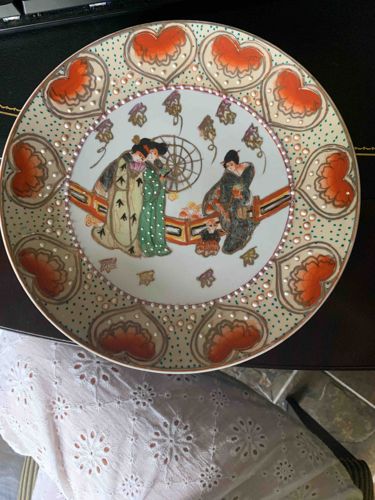
Vintage kutani Japanese porcelain Geisha Deco Plate
These notes were written by the person who submitted this item. Appraiser.AI has not verified them, and the AI's identification and estimate may rely on them.
AI Estimated Value
Not an official valuation
$45 - $75
AI estimate as of August 9, 2025 · verify with a professional before acting
AI-Generated · Verify before acting
Everything on this page is generated by AI for informational purposes only. AI can make mistakes — the AI may misidentify items or misattribute them (artist, maker, brand, designer, origin, era). This is not an official valuation and should not be used for insurance, sale, tax, estate, legal, or lending purposes — or any decision requiring a certified appraisal. It is not an authoritative claim about any person, brand, or rights holder — do not share or rely on it as a factual statement about a third party. Always consult qualified professionals before making financial decisions.
This analysis also relies on unverified notes provided by the user, which may be incomplete or inaccurate and could affect the result.
This is a vintage Kutani Japanese porcelain decorative plate, likely from the Art Deco period, featuring a hand-painted scene with Geisha figures. The plate has a circular form with a slightly raised rim. The central design depicts three Geisha-like women in traditional attire, rendered with a distinctive stylized approach. One figure is kneeling, while two others stand, appearing to interact, possibly near a spinning wheel or a similar domestic object, and what looks like a low table or barrier. The colors used for the figures' kimonos are rich, predominantly green, black, and orange with intricate patterns and gold accents. The background of the central scene is a light, almost celadon green. A decorative border surrounds the central image, comprising a series of repeating heart-shaped motifs in a vibrant orange, outlined and filled with subtle patterns and dots. This border is set against a lighter, textured background with numerous tiny, raised dots, possibly created by moriage or raised enamel technique, adding tactile dimension. There's also a delicate pink or reddish-brown thin line acting as an inner rim or divider between the central scene and the patterned border. The overall condition appears good, with no immediately visible chips, cracks, or significant wear, though a comprehensive assessment would require a back inspection for maker's marks or damage. The craftsmanship suggests hand-painting, visible in the brushstrokes and slight variations in the motifs, indicating a good quality production. The Art Deco influence is evident in the stylized figures and bold color choices, typical of export ware from the early to mid-20th century.
AI Appraisal Report
Upon examination of the provided images, this Kutani Japanese porcelain plate presents as a quality example of export ware from the Taisho or early Showa period, aligning with the Art Deco era (c. 1920s-1930s). The hand-painted central scene featuring three stylized figures, likely Geisha, is rendered with care, and the rich color palette of green, black, and orange with gold accents is characteristic of Kutani ware from this time. The distinctive orange border with heart-shaped motifs and the raised moriage-style dot background add both visual interest and tactile dimension, suggesting good craftsmanship.
The plate appears to be in very good condition based on the visual evidence, with no obvious chips, cracks, or crazing. The value is largely determined by its condition, artistry, and decorative appeal. The market for Japanese porcelain of this period is steady, with collectors particularly interested in well-preserved pieces that exhibit strong design elements. This plate's Art Deco influence enhances its desirability.
However, this appraisal is limited by the inability to physically inspect the item. A full authentication would require examining the reverse side for a maker’s mark or Kutani seal (九谷), which would significantly impact its value and provenance. Without handling the plate, I cannot definitively assess the quality of the porcelain body, confirm the nature of the raised enamel, or check for hairline cracks or restorations not visible in photos. For a certified appraisal, a physical inspection is essential.