AI estimate as of July 10, 2025 · verify with a professional before acting
AI-Generated · Verify before acting
Everything on this page is generated by AI for informational purposes only. AI can make mistakes — the AI may misidentify items or misattribute them (artist, maker, brand, designer, origin, era). This is not an official valuation and should not be used for insurance, sale, tax, estate, legal, or lending purposes — or any decision requiring a certified appraisal. It is not an authoritative claim about any person, brand, or rights holder — do not share or rely on it as a factual statement about a third party. Always consult qualified professionals before making financial decisions.
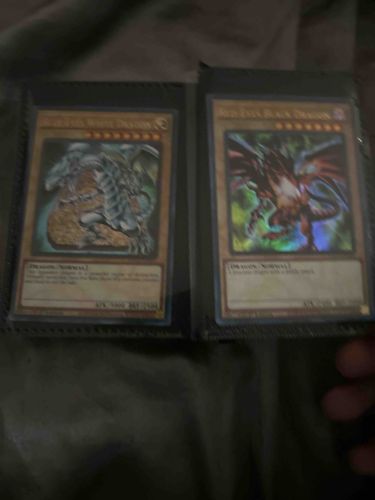
The image displays two Yu-Gi-Oh! trading cards, presumably stored within a protective binder or clear card sleeves. The card on the left is identifiable as 'Blue-Eyes White Dragon', depicted by a formidable white-scaled dragon. The card on the right is 'Red-Eyes Black Dragon', showing a powerful red and black dragon. Both cards appear to be 'Normal Monsters' based on the visible text. The art on the 'Red-Eyes Black Dragon' card seems to be a holographic foil, indicated by the reflective and shifting colors visible, particularly evident in the background and potentially on the dragon itself. The 'Blue-Eyes White Dragon' card does not show strong holographic properties in this image, suggesting it might be a non-foil or a different rarity. Both cards are rectangular, typical of trading cards, and made of a stiff paper or cardstock material. The edges of the cards appear to be relatively sharp, suggesting good condition, though the resolution of the image makes it difficult to ascertain minor wear such as corner dings or surface scratches. The text boxes at the bottom of each card contain lore or descriptive text and combat statistics (ATK/DEF), which are partially visible. The overall condition seems good from the limited view, with no obvious major damage, although the lighting is somewhat dim. These cards are iconic monsters from the early eras of the Yu-Gi-Oh! Trading Card Game, dating them likely to the late 1990s or early 2000s, or later reprints of these classic cards.
AI Appraisal Report
I have examined the provided image displaying two Yu-Gi-Oh! trading cards: 'Blue-Eyes White Dragon' and 'Red-Eyes Black Dragon'. Based on the visual evidence, both cards appear to be 'Normal Monsters'. The 'Red-Eyes Black Dragon' exhibits clear holographic properties, suggesting it's a foil variant, which typically commands a higher value than non-foil versions. The 'Blue-Eyes White Dragon' does not show obvious foiling in this image. The overall condition, while difficult to ascertain precisely due to image resolution and lighting, appears good with no obvious major damage, sharp edges, and relatively flat surfaces. These are iconic, highly sought-after cards from the early Yu-Gi-Oh! era, which generally increases their demand even as reprints. However, determining their specific set, print run, and edition (e.g., 1st Edition, Unlimited) is crucial for accurate valuation, and this cannot be determined from the image alone. Market conditions for these specific cards are highly volatile and depend heavily on their exact variant and authenticated condition. Comparables for early print, graded versions can range from hundreds to thousands of dollars, while common reprints might be significantly less. The primary limitation is the inability to verify authenticity, exact edition, and precise condition (e.g., surface scratches, corner nicks, print defects) without physical inspection. For full authentication and a definitive valuation, I would require in-person examination, allowing for detailed scrutiny under proper lighting, verification of card texture and print quality, and potentially grading by a reputable third-party service like PSA or BGS. Provenance documentation, if available, would also be beneficial.