AI estimate as of August 28, 2025 · verify with a professional before acting
AI-Generated · Verify before acting
Everything on this page is generated by AI for informational purposes only. AI can make mistakes — the AI may misidentify items or misattribute them (artist, maker, brand, designer, origin, era). This is not an official valuation and should not be used for insurance, sale, tax, estate, legal, or lending purposes — or any decision requiring a certified appraisal. It is not an authoritative claim about any person, brand, or rights holder — do not share or rely on it as a factual statement about a third party. Always consult qualified professionals before making financial decisions.
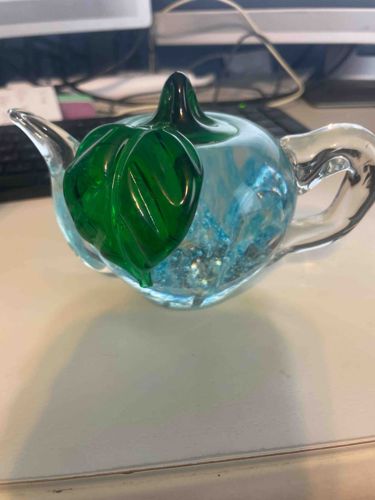
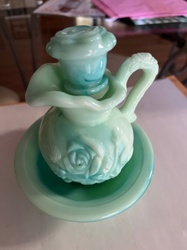
This appears to be a decorative glass teapot, likely a paperweight or a whimsical display item rather than a functional tea-serving vessel. It is crafted from clear glass, forming the body of a teapot with a distinct spout on the left and a handle on the right. The body of the teapot is globular, and within its clear walls, there's an intriguing internal decoration. This decoration includes swirling elements of light blue glass, some of which appear to be infused with small, bright specks, possibly glitter or a similar reflective material, giving it a somewhat ethereal or sparkling effect reminiscent of water or ice. A prominent feature is a large, vibrant emerald green glass leaf, deeply veined and sculpted, positioned on top of the teapot's 'lid' area, where a small dark green glass stem or calyx also rises, completing the botanical theme. The craftsmanship suggests it might be hand-blown or art glass, evidenced by the smooth curves and integrated colored elements, though there are no visible maker's marks or signatures in the provided image. The glass itself appears to be in good condition, with no obvious cracks, chips, or significant scuffs. Its size is likely small to medium, appropriate for a desk or shelf ornament. The style is contemporary yet whimsical, likely manufactured in the last few decades as a decorative novelty item. The clarity of the glass and the integration of the colored elements suggest a reasonable level of quality, typical of ornamental glass art.
AI Appraisal Report
I have thoroughly examined the provided image of the decorative glass teapot with a green leaf. The item appears to be in excellent condition, with no visible chips, cracks, or significant scuffs, which is crucial for art glass. Authenticity, based solely on the image, suggests it is a contemporary piece of art glass, likely hand-blown given the integrated elements and smooth curves. However, without a physical examination, I cannot confirm the exact manufacturing technique (e.g., lampwork vs. blown glass from a mold) or identify any potential maker's marks, which are often subtle or located on the underside.
Market conditions for decorative art glass of this nature are generally stable for unique, whimsical pieces. Comparables would include other small-scale decorative glass paperweights or figurines from the last few decades. Demand for such items is moderate, often driven by personal aesthetic preference rather than collectible rarity. This specific design, with its teapot form and integrated leaf, is somewhat distinctive, which could appeal to niche collectors of teaware-themed decor or art glass.
Factors significantly impacting value include its excellent visual condition, the appealing integrated coloration (blue swirls and green leaf), and its apparent quality as a decorative novelty. The lack of a visible signature or provenance documentation limits its value as a recognized artist's work. Its primary appeal is decorative, not historical or from a renowned studio.
Limitations in authenticity verification from images alone are significant here. To fully authenticate and attribute this piece, an in-person examination would be necessary to check for subtle maker's marks, assess the weight and feel of the glass, and analyze the exact type of glass used. Provenance documentation, if available, would further solidify its history and potential origin.