AI estimate as of November 3, 2025 · verify with a professional before acting
AI-Generated · Verify before acting
Everything on this page is generated by AI for informational purposes only. AI can make mistakes — the AI may misidentify items or misattribute them (artist, maker, brand, designer, origin, era). This is not an official valuation and should not be used for insurance, sale, tax, estate, legal, or lending purposes — or any decision requiring a certified appraisal. It is not an authoritative claim about any person, brand, or rights holder — do not share or rely on it as a factual statement about a third party. Always consult qualified professionals before making financial decisions.
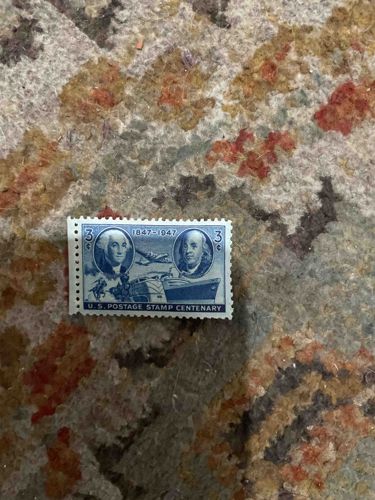
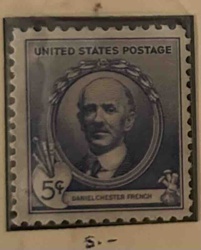
This is a United States postage stamp commemorating the centenary of U.S. postage stamps, issued in either 1947 or 1948. The stamp features a central design depicting significant modes of communication and transportation throughout the period 1847-1947. On the left side, within an oval frame, is a portrait of George Washington, and on the right, within a similar oval frame, is a portrait of Benjamin Franklin. Between these two historical figures, there are illustrations of various conveyances, including a small, early locomotive (train), a sailing ship, and an airplane, symbolizing postal delivery methods over a century. The denomination '3' appears in the top-left and top-right corners, while '1847-1947' is printed at the top center. Below the main design, the text 'U.S. POSTAGE STAMP CENTENARY' is clearly visible. The stamp is blue in color and features perforated edges, characteristic of postage stamps designed for separation from a sheet. The condition appears to be relatively good, with no obvious major tears, creases, or heavy cancellations visible from the image. The perforations seem intact, and the imagery is sharp, indicating reasonable preservation for its age. The overall aesthetic is clean, suggesting it might be an uncancelled or lightly cancelled stamp, though the reverse side is not visible to confirm absence of adhesive or postmarks. It exhibits the typical characteristics of a mid-20th-century commemorative postage stamp.
AI Appraisal Report
Upon visual examination of the provided image of the U.S. Postage Stamp Centenary (1847-1947) 3-Cent Stamp, I assess its condition as relatively good to very good. The perforations appear intact and well-separated from the image edges, and the visual clarity of the central design, including the portraits of Washington and Franklin, and the conveyances, is sharp. The rich blue coloration is consistent with known examples of Scott #947. There are no obvious major tears, creases, or heavy cancellations visible, suggesting it may be unused or very lightly postmarked. As such, it presents as a clean example for its age.
From a market perspective, this stamp (Scott #947) is a common commemorative issue from the mid-20th century. Millions of copies were produced and distributed. Consequently, rarity is extremely low. Demand exists primarily among general collectors or those assembling a complete U.S. commemorative collection rather than high-end philatelists seeking rare items. Current market comparables for unused examples in similar condition typically range from $0.20 to $0.50, while a fine used example might fetch $0.20 to $0.75. Factors impacting value significantly are primarily condition; any heavy cancellation, toning, creasing, or missing perforations would diminish its value to minimal or face value.
It is crucial to note that this appraisal is based solely on the provided image. Authenticity verification is limited; while the design matches a genuine Scott #947, without physical inspection, I cannot confirm the integrity of the gum (if unused), check for hidden perforations faults, repairs, or re-perforated edges. An in-person examination would be required to verify the exact shade, paper type, gum condition (for unused), and to detect any subtle flaws not visible in the image. Provenance documentation would add to its history, but for such a common issue, it\'s not a primary factor for authentication or value.