AI estimate as of July 21, 2025 · verify with a professional before acting
AI-Generated · Verify before acting
Everything on this page is generated by AI for informational purposes only. AI can make mistakes — the AI may misidentify items or misattribute them (artist, maker, brand, designer, origin, era). This is not an official valuation and should not be used for insurance, sale, tax, estate, legal, or lending purposes — or any decision requiring a certified appraisal. It is not an authoritative claim about any person, brand, or rights holder — do not share or rely on it as a factual statement about a third party. Always consult qualified professionals before making financial decisions.
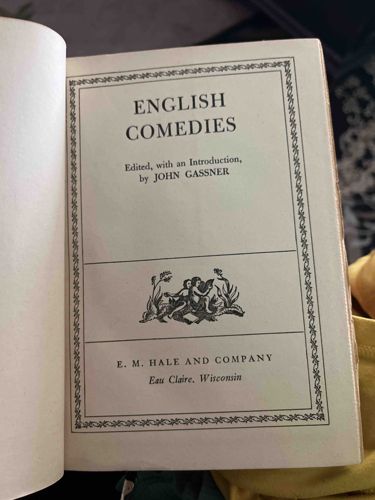
The item is an open book, revealing its title page. The primary color of the page is an off-white or cream, indicating aged paper. The text and decorative elements are printed in black ink. The title, 'ENGLISH COMEDIES', is prominently displayed in a large, bold serif font. Beneath it, 'Edited, with an Introduction, by JOHN GASSNER' is printed in a slightly smaller, less bold serif font. A notable feature is the intricate decorative border that frames the entire page, composed of a repeating floral or vine-like pattern, adding an aesthetic touch characteristic of many older printed books. Below the editor's credit, there is a charming black and white illustration depicting two figures with classical attire, possibly muses or mythological characters, surrounded by foliage and what appears to be a fountain or basin. This illustration is rendered in a detailed, somewhat whimsical style. At the bottom of the page, the publisher's information is displayed: 'E. M. HALE AND COMPANY' and 'Eau Claire, Wisconsin,' indicating the place of publication. The paper exhibits some yellowing consistent with age, suggesting it is an older publication, likely from the mid-20th century or earlier, judging by the publishing company and the aesthetic. There are no visible tears, significant creases, or major stains on this specific page, suggesting it is in relatively good condition for its age. The binding on the left appears intact, allowing the book to lay open flat enough to clearly read the page. The overall quality of printing and the decorative elements suggest a well-produced volume.
AI Appraisal Report
Upon examining the provided image of 'English Comedies Edited by John Gassner,' I observe an open book displaying its title page. The paper's off-white hue and visible yellowing are consistent with age, suggesting a mid-20th century or earlier publication. The intricate decorative border and classical illustration are characteristic of the period's book design, enhancing its aesthetic appeal. The page appears to be in relatively good condition, with no visible tears or significant creases, which is a positive factor for its age. The publisher, E. M. Hale and Company of Eau Claire, Wisconsin, is a relatively minor and regional publisher; books from such presses typically do not command high values unless they contain significant literary works or unique historical importance. John Gassner was a respected theater critic and editor but not a first-tier literary figure whose edited works consistently fetch high prices.
In terms of market conditions, similar anthologies or edited collections from this period, even in good condition, usually have modest demand unless they are first editions of highly sought-after individual plays or contain exceptionally rare content. This particular volume appears to be a standard collection. Rarity is not a significant factor here; such edited volumes were often produced in substantial print runs. The primary value drivers are its good condition for its age and its aesthetic appeal as an older book.
My primary limitation in this appraisal is the lack of physical examination. While the image shows the title page clearly, I cannot definitively assess the condition of the entire book, the binding's integrity throughout, or the presence of any inscriptions or foxing on other pages. A physical inspection would allow me to verify the paper quality fully, check for marginalia, assess the overall binding health, and confirm the specific edition and printing. This would also aid in definitively ruling out any modern reprints designed to mimic older books. Provenance documentation would be ideal to establish a clear chain of ownership, although for volumes of this type, it's rarely necessary for valuation unless a specific historical owner is involved. Scientific testing is generally not required for authenticity of such books unless there are specific concerns about paper or ink forgery.