These notes were written by the person who submitted this item. Appraiser.AI has not verified them, and the AI's identification and estimate may rely on them.
AI Estimated Value
Not an official valuation
$25-50
AI estimate as of July 27, 2025 · verify with a professional before acting
AI-Generated · Verify before acting
Everything on this page is generated by AI for informational purposes only. AI can make mistakes — the AI may misidentify items or misattribute them (artist, maker, brand, designer, origin, era). This is not an official valuation and should not be used for insurance, sale, tax, estate, legal, or lending purposes — or any decision requiring a certified appraisal. It is not an authoritative claim about any person, brand, or rights holder — do not share or rely on it as a factual statement about a third party. Always consult qualified professionals before making financial decisions.
This analysis also relies on unverified notes provided by the user, which may be incomplete or inaccurate and could affect the result.
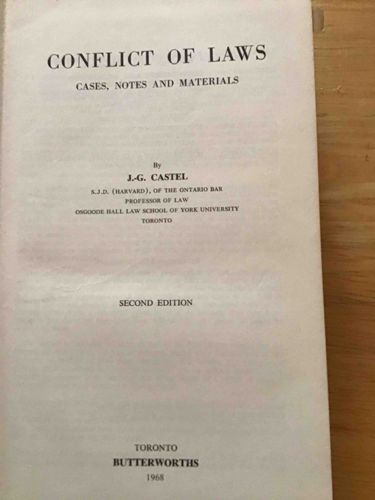
The item is a vintage legal textbook titled "CONFLICT OF LAWS CASES, NOTES AND MATERIALS." The book presents a softcover or paperback binding, showing a slight curl or warp at the top right corner, suggesting it might be either a softcover book or a large section of a hardcover book that is no longer fully bound. The pages are off-white, exhibiting a natural aging or tanning characteristic of paper from the mid-20th century. The text is printed in black ink, with clear, legible sans-serif and serif fonts used for the heading and body text, respectively. Prominently featured on the visible page (likely the title page) are the author's details: "By J.-G. CASTEL, S.J.D. (HARVARD), OF THE ONTARIO BAR, PROFESSOR OF LAW, OSGOODE HALL LAW SCHOOL OF YORK UNIVERSITY, TORONTO." It is identified as the "SECOND EDITION." The publisher is "BUTTERWORTHS" located in "TORONTO," and the publication year is clearly stated as "1968." The visible page appears to be in good condition, as stated in the context, with no apparent tears, significant creases, or large stains. There might be some subtle discoloration or mild foxing consistent with a book of this age, but overall it retains its integrity. The binding edge (left side of the image) appears relatively clean, without immediate signs of heavy wear, although the full extent of the binding's condition is not visible. The craftsmanship suggests a standard academic publication of its time, designed for readability and durability in an educational or professional setting.
AI Appraisal Report
I have examined the provided image of the "CONFLICT OF LAWS CASES, NOTES AND MATERIALS" (Second Edition, 1968) by J.-G. Castel. Based on the visual evidence, the book appears to be in good condition, aligning with the owner's description. The off-white pages, characteristic of mid-20th-century paper, show no significant tears, major creases, or substantial stains on the visible title page. The slight curl at the top right suggests a softcover or a large untrimmed section, which is common for academic texts of this era. The legible print and intact binding edge (partially visible) further support the 'good condition' assessment. Authenticity is strongly indicated by the clear bibliographic details: author, title, 'SECOND EDITION,' publisher 'BUTTERWORTHS TORONTO,' and the prominent '1968' publication year. These details are consistent with known publications by J.-G. Castel. In terms of market conditions, vintage academic legal textbooks typically have a niche but consistent demand, primarily from libraries, law students, scholars, or collectors specializing in legal history. This particular text, dealing with conflict of laws, holds academic relevance, though its value is more historical than practical for current legal practice. It is not considered rare; many copies of academic texts from this period were printed. The primary factors impacting its value are its good condition for its age and its identity as a foundational legal text in a specific academic field. While the image provides a solid basis for appraisal, an in-person examination would allow for a full assessment of the binding integrity, true extent of page discoloration or foxing, presence of any internal markings or highlights, and a definitive confirmation of the softcover or flexible binding type. Provenance documentation (e.g., previous ownership) could add marginal value but is not crucial for a standard academic text of this nature. Scientific testing is unnecessary for authenticity here.