AI Appraisal Estimate

AI-generated estimates · not official valuations

From the user

What was submitted

Photo and notes provided by the user — not generated by AI

Submitted item photo
Submitted photo · June 17, 2026

User's notes

No additional notes provided.

AI analysis below

AI appraisal

AI analysis & estimate

AI-Generated · Verify before acting

Everything below is generated by AI for informational purposes only. AI can make mistakes — the AI may misidentify items or misattribute them (artist, maker, brand, designer, origin, era). This is not an official valuation and should not be used for insurance, sale, tax, estate, legal, or lending purposes — or any decision requiring a certified appraisal. It is not an authoritative claim about any person, brand, or rights holder — do not share or rely on it as a factual statement about a third party. Always consult qualified professionals before making financial decisions.

Read the full disclaimer

AI Identification

·Not independently authenticated·Verify before acting

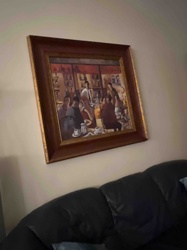
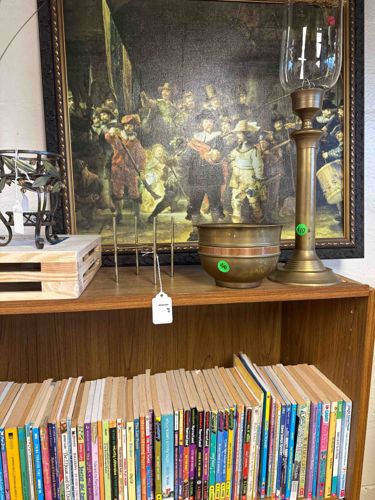
Framed Reproduction of Rembrandt's The Night Watch

Fine Art / Wall Decor

AI Estimated Value

·Not an official valuation·Verify before acting

$75 - $150

As of June 17, 2026

AI Item Analysis

·AI can make mistakes·Verify before acting
This item is a framed print or canvas reproduction of Rembrandt van Rijn’s famous 1642 masterpiece, officially titled 'Militia Company of District II under the Command of Captain Frans Banninck Cocq', commonly known as 'The Night Watch'. The piece exhibits the characteristic baroque use of chiaroscuro (strong contrasts between light and dark) to depict a group of Dutch civic guardsmen. The scene is presented in a large format within a substantial, ornate composite or wooden frame. The frame features a dark, perhaps ebony-finished outer molding with a beaded or textured interior gilt edge, suggesting a traditional or transitional style consistent with late 20th-century home decor. Physically, the artwork appears to be a textured print surface, possibly on board or canvas, which mimics the original oil-on-canvas brushwork. The colors are dominated by earthy ochres, deep blacks, and muted reds, which are typical of the aged varnish appearance of the original. The condition shows some surface dust and minor scuffing on the frame edges, consistent with being displayed in a retail or thrift setting. There are no immediately visible rips in the substrate, though the overall luminosity is slightly flattened compared to the original due to the reproduction process. A green price sticker is visible on the glass of a lamp in front of it, and the piece sits behind several decorative objects on a wooden shelf, making detailed examination of the lower canvas edge and potential artist/manufacturer signatures difficult. The scale suggests it is intended as a prominent wall statement piece.

AI Appraisal Report

·AI can make mistakes·Verify before acting
I have conducted a visual examination of this reproduction of Rembrandt’s 1642 masterpiece, 'The Night Watch.' The item is a mass-produced decorative print, likely a giclée or textured lithograph on board, presented in a large-scale, ornate composite frame. The frame features an ebony finish with a gilded interior lip, characteristic of high-end home decor pieces from the late 20th century rather than fine art gallery standards. Condition-wise, the piece appears structurally sound but exhibits surface dust and minor abrasions to the frame’s molding consistent with secondary-market handling. The 'flattened' luminosity and standard color saturation confirm this is a mechanical reproduction intended for interior design rather than a hand-painted copy or a limited-edition artist-signed lithograph. The market for such reproductions is saturated; demand is driven primarily by size and framing quality rather than the rarity of the image itself. Comparables found in estate sales and mid-tier thrift environments generally fall within the $50 to $200 range, depending on the scale and frame weight. The significant value here lies in the frame, as custom framing for a piece of this size would exceed several hundred dollars. Limitations: This appraisal is based solely on visual inspection of the provided description and image. A physical examination is required to determine the exact substrate (canvas vs. textured paper) and to check for hidden damage or acidity in the backing. To rule out the extremely unlikely possibility of a 19th-century academic copy, I would need to examine the reverse for historical labels, analyze the pigment under UV light, and check for authentic craquelure (surface cracking) versus embossed mechanical texture.

Get your items appraised

Instant estimates of your treasures with AI-powered appraisals

Browse More Appraisals