AI estimate as of September 2, 2025 · verify with a professional before acting
AI-Generated · Verify before acting
Everything on this page is generated by AI for informational purposes only. AI can make mistakes — the AI may misidentify items or misattribute them (artist, maker, brand, designer, origin, era). This is not an official valuation and should not be used for insurance, sale, tax, estate, legal, or lending purposes — or any decision requiring a certified appraisal. It is not an authoritative claim about any person, brand, or rights holder — do not share or rely on it as a factual statement about a third party. Always consult qualified professionals before making financial decisions.
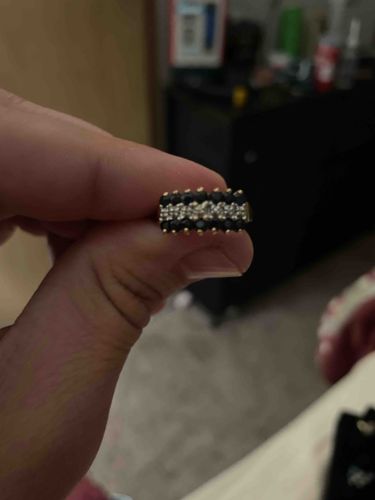
The item is a ring, likely a band-style ring due to its consistent width and multi-row design, specifically held between a person's thumb and forefinger. It features a striking contrast of dark and light gemstones set into what appears to be a gold-colored metal. The ring has a rectangular or slightly curved top surface, densely embellished with multiple rows of stones. There are three prominent rows visible: the central row consists of clear or white gemstones, possibly diamonds or cubic zirconia, set closely together to form a continuous line of brilliance. Flanking this central row on both sides are rows of dark, opaque gemstones, most likely black onyx or black diamonds/spinel, providing a stark visual contrast. The settings for the stones appear to be individual prongs or bead settings, which securely hold each stone in place and contribute to the textured surface. The overall construction suggests a robust and well-made piece, with no immediately apparent visible damage such as missing stones, significant scratches, or deformities. The metal has a consistent warm, golden hue, indicating it could be yellow gold or a gold-plated base metal. The craftsmanship appears to be of good quality, with stones evenly spaced and set. Given the multi-stone, contrasting color design, it could be a contemporary or vintage piece, perhaps from the late 20th to early 21st century. The size is typical for a finger ring, being small enough to fit on a digit but substantial enough to carry the intricate stone work.
AI Appraisal Report
Upon visual examination of the Multi-Row White and Black Gemstone Gold-Tone Ring, I assess its condition as very good to excellent. The metal exhibits a consistent warm, golden hue, suggesting it could be gold plating over a base metal, or a lower karat gold alloy. The stones, appearing as three rows—a central row of clear/white gemstones flanked by dark opaque stones—are uniformly set, showing no immediate signs of chips, cracks, or looseness. The craftsmanship seems solid, with all stones present and settings intact, contributing to a robust appearance.
From the image alone, authenticating the type of gemstones and metal is impossible. The white stones could be diamonds, moissanite, or cubic zirconia, while the black stones could be onyx, spinel, or black diamonds. Without a jeweler's loupe, specific gravity tests, or refractive index measurements, their true identity cannot be confirmed. Similarly, metal testing (e.g., acid test or XRF analysis) would be required to determine if it is solid gold, gold-filled, or gold-plated.
Market conditions for multi-gemstone rings with contrasting colors are generally stable, with demand for stylish, well-made pieces. This design, offering a bold visual statement, tends to appeal to a broad consumer base. Comparable items in the costume jewelry market, often made with gold-tone metals and simulated gemstones, typically retail in the $75-$250 range. If the metal were confirmed as solid 10k or 14k gold with genuine, albeit lower-grade, gemstones, the value would significantly increase. However, based solely on visual cues and the likely possibility of a gold-toned base metal with non-diamond/precious stones, I place the value within the costume or entry-level fine jewelry category.
The primary factors impacting value are the unknown composition of the metal and gemstones. Without in-person inspection and detailed material analysis, definitive authenticity verification is limited. Provenance documentation, if available, could also shed light on the materials and origin, further aiding a precise valuation.