AI estimate as of August 9, 2025 · verify with a professional before acting
AI-Generated · Verify before acting
Everything on this page is generated by AI for informational purposes only. AI can make mistakes — the AI may misidentify items or misattribute them (artist, maker, brand, designer, origin, era). This is not an official valuation and should not be used for insurance, sale, tax, estate, legal, or lending purposes — or any decision requiring a certified appraisal. It is not an authoritative claim about any person, brand, or rights holder — do not share or rely on it as a factual statement about a third party. Always consult qualified professionals before making financial decisions.
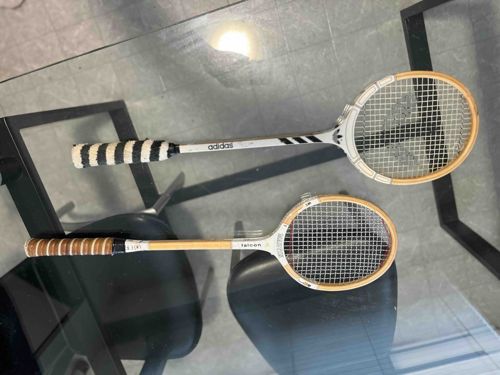
This lot consists of two vintage badminton rackets, likely dating from the mid to late 20th century, possibly the 1970s or 1980s, given their construction and visible branding. Both rackets feature traditional wooden frames with natural wood finishes on the heads, indicating a classic construction style before the widespread adoption of graphite and other composite materials. The strings appear to be synthetic, typical of the period, and are arranged in a standard grid pattern.
The first racket, positioned at the top, is an Adidas brand racket. It has a white shaft with distinct black diagonal stripes, a hallmark of the Adidas brand. The handle is wrapped with a black and white striped grip, showing significant signs of wear and fraying, suggesting extensive use or age-related deterioration of the grip material. The strings are intact, but their tension cannot be assessed from the image. The wooden head frame shows light wear consistent with play. The Adidas logo is clearly visible on the shaft.
The second racket, positioned below, is branded 'Falcon'. Its shaft appears to be a natural wood finish, lighter in color compared to the white Adidas shaft. The handle is wrapped with a brown and cream-striped grip, which also exhibits wear, though perhaps not as severe as the Adidas racket's grip. The strings are intact, and the overall condition of the wooden head seems good. Both rackets display a level of craftsmanship consistent with mass-produced sporting goods of their era, intended for recreational play. There are no visible major breaks or repairs, but surface wear, especially on the handles, is evident. The rackets appear to be of standard adult size for badminton.
AI Appraisal Report
Upon examining the provided image of the two vintage wooden badminton rackets, I can offer the following appraisal. Both rackets appear to be authentic examples of mass-produced sporting goods from the mid to late 20th century, likely the 1970s or 1980s, consistent with their wooden construction and branding. The Adidas racket, with its distinctive white shaft and black diagonal stripes, aligns well with the brand's aesthetics of that era. The 'Falcon' racket also appears period-appropriate.
Condition-wise, both rackets exhibit fair to good vintage condition. The wooden frames show expected light wear but no visible major breaks or structural damage. The strings appear intact on both. The most significant condition factor impacting value is the severe wear and fraying of the handle grips, particularly on the Adidas racket. This is common for items of this age and intended use, but it does detract from collectible appeal.
From a market perspective, vintage wooden badminton rackets, even branded ones, generally do not command high values unless they are exceptionally rare, associated with a famous player, or in pristine, unused condition. These appear to be recreational models. Comparables in the online marketplace for similar vintage recreational wooden rackets typically range from $15 to $40 individually, with a slight premium for recognizable brands like Adidas. The common nature of these items limits rarity and, consequently, demand among serious collectors.
Limitations: While the visual evidence strongly suggests authenticity and provides a good indication of condition, a full, in-person examination would be necessary for definitive authentication. This would allow for tactile inspection of materials, precise measurement, assessment of string tension, and a thorough search for any subtle repairs or defects not visible in the image. Provenance documentation (e.g., original purchase receipts, historical context) would also add to authentication but is rarely available for such recreational items.