These notes were written by the person who submitted this item. Appraiser.AI has not verified them, and the AI's identification and estimate may rely on them.
AI Estimated Value
Not an official valuation
$400 - $1,200
AI estimate as of June 22, 2025 · verify with a professional before acting
AI-Generated · Verify before acting
Everything on this page is generated by AI for informational purposes only. AI can make mistakes — the AI may misidentify items or misattribute them (artist, maker, brand, designer, origin, era). This is not an official valuation and should not be used for insurance, sale, tax, estate, legal, or lending purposes — or any decision requiring a certified appraisal. It is not an authoritative claim about any person, brand, or rights holder — do not share or rely on it as a factual statement about a third party. Always consult qualified professionals before making financial decisions.
This analysis also relies on unverified notes provided by the user, which may be incomplete or inaccurate and could affect the result.
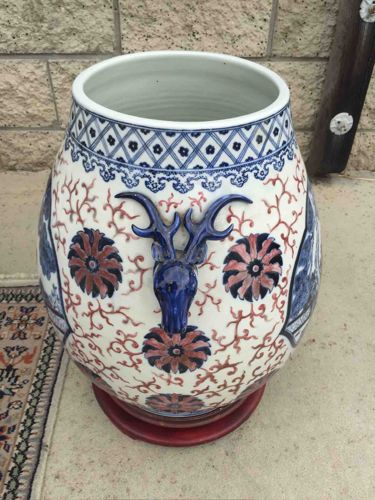
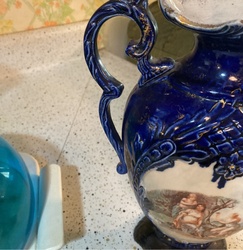
This is a large, ornate Asian porcelain vase, likely Chinese or Japanese, characterized by its rounded, stout form and slightly inward-tapering neck. The primary colors are a vibrant cobalt blue, a rusty red/orange, and a pristine white base porcelain. The decoration features a complex pattern of intertwining red-orange stylized vines or tendrils covering the body. Scattered within this pattern are large, circular floral motifs in the same reddish-orange hue with dark centers, suggesting a chrysanthemum or similar bloom. A distinctive feature is the presence of three-dimensional, applied deer heads (or possibly mythological beasts with antlers) in dark blue, strategically placed as decorative handles or embellishments on the vase's shoulders. The top rim of the vase is adorned with an intricate blue and white geometric border, possibly a diaper pattern, featuring diamond and quatrefoil shapes. Below this geometric band is a detailed blue frieze with swirling motifs, providing a clear division between the neck and the main body. The interior of the vase appears to be a plain off-white or light cream color, consistent with unglazed or lightly glazed porcelain. The vase sits on a separate, reddish-brown wooden stand, which is common for large decorative Asian pottery, elevating it slightly and completing its presentation. The overall condition appears good, with no obvious chips or cracks visible from the provided images, though a full inspection would be required to confirm this. The craftsmanship suggests a piece designed for decorative display, and its style points to a traditional Asian aesthetic, possibly from the late 19th or early 20th century, though dating would require closer examination of the base and any potential reign marks. The quality indicators include the richness of the glazes, the intricacy of the painted patterns, and the three-dimensional applied elements, all contributing to its decorative appeal.
AI Appraisal Report
Upon visual examination of the provided images, this large Asian porcelain vase is a striking decorative item. The combination of iron-red enameling for the dense vine and floral pattern and cobalt blue for the applied deer-head handles and border friezes is consistent with decorative styles from late 19th to early 20th century China. The overall condition appears excellent, with vibrant glazes and no obvious chips or cracks. The presence of a complementary wooden stand adds to its display value and completeness.
The market value of this vase is highly dependent on its precise age and origin. The market for authentic, period Chinese porcelain is robust. However, many high-quality reproductions of this style were made throughout the 20th century. A genuine late Qing or early Republic piece could command a significant price, whereas a later reproduction would have primarily decorative value.
Critically, authenticity cannot be confirmed from photographs alone. A full appraisal requires physical examination to assess the weight of the porcelain, the texture of the glaze, and the wear on the footrim. Most importantly, I would need to inspect the underside of the base for any reign marks or symbols, which are crucial for dating. Without such inspection or provenance documentation, this appraisal is preliminary.