AI Appraisal Estimate

AI-generated estimates · not official valuations

From the user

What was submitted

Photo and notes provided by the user — not generated by AI

Submitted item photo
Submitted photo · May 16, 2026

User's notes

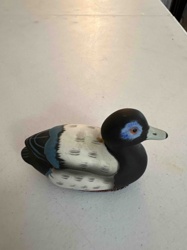
Pair of Ward Brothers carved wood bookends

AI analysis below

AI appraisal

AI analysis & estimate

AI-Generated · Verify before acting

Everything below is generated by AI for informational purposes only. AI can make mistakes — the AI may misidentify items or misattribute them (artist, maker, brand, designer, origin, era). This is not an official valuation and should not be used for insurance, sale, tax, estate, legal, or lending purposes — or any decision requiring a certified appraisal. It is not an authoritative claim about any person, brand, or rights holder — do not share or rely on it as a factual statement about a third party. Always consult qualified professionals before making financial decisions.

Note

This analysis also relies on unverified notes provided by the user, which may be incomplete or inaccurate and could affect the result.

Read the full disclaimer

AI Identification

·Not independently authenticated·Verify before acting

Ward Brothers Style Hand-Carved Wooden Duck Decoy Bookends

American Folk Art / Sporting Collectibles

AI Estimated Value

·Not an official valuation·Verify before acting

$450 - $700

As of May 16, 2026

AI Item Analysis

·AI can make mistakes·Verify before acting
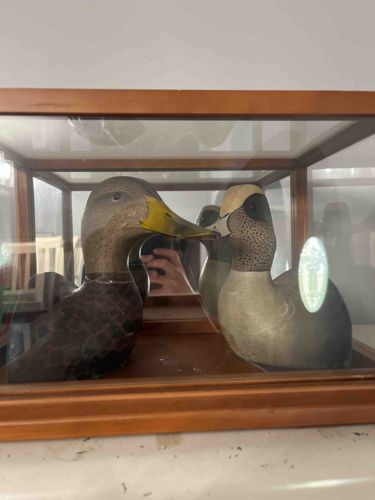
A pair of hand-carved and hand-painted wooden duck decoy bookends, currently displayed within a glass and wood protective case. These carvings represent the folk art tradition made famous by Lemuel and Steve Ward of Crisfield, Maryland. The pair consists of two distinct species: a Black Duck and an American Wigeon (Baldpate). The Black Duck features a deep brownish-black body with high-relief, hand-painted feather detailing and a bright yellow-green bill. The Wigeon possesses the characteristic white crown, green eye patch, and gray speckled cheeks common to the species. Both decoys are carved with the realistic, fluid neck lines and expressive head positions typical of the Ward Brothers style from the mid-20th century. The construction appears to be high-quality solid wood with a matte finish that exhibits a light age-related patina. There are minor abrasions visible on the bills and some light surface dust, but the paint remains largely vibrant with little evidence of significant flaking or structural cracking. The glass case features a mirrored back, which provides a 360-degree view of the craftsmanship and emphasizes the depth of the wood carving. These items represent a intersection of American sporting art and domestic functional decor, likely dating from the 1960s to the 1980s based on the decorative finish and condition.
AI Appraisal Report

·AI can make mistakes·Verify before acting
I have conducted a professional visual assessment of the hand-carved duck decoy bookends, styled after the legendary Ward Brothers. Based on the provided imagery, the carvings—representing a Black Duck and an American Wigeon—exhibit the fluid anatomy and expressive head positioning characteristic of the 'Ward Style.' The condition appears to be 'Good to Very Good,' with the paint retaining its vibrancy while showing a light, desirable patina consistent with the 1960s-1980s period. Minor abrasions on the bills are consistent with age and typical of functional folk art. The market for sporting collectibles remains steady, though values for decorative bookends are generally lower than for genuine competition-grade or vintage working decoys used for hunting. The inclusion of the mirrored display case adds to the aesthetic appeal but suggests these were produced for the giftware or collector markets. Comparables for high-quality vintage Ward-style bookends typically fall within the $400-$800 range depending on the specific carver associated with the work. A significant limitation of this appraisal is the inability to confirm the carver's identity via signatures or stamps, which are often concealed on the base. For a definitive authentication, I would require an in-person physical inspection to assess wood density, tool marks, and specific paint layering techniques. I would also seek provenance documentation, such as original sales receipts or exhibition history. Without a verified signature or 'L.T. Ward' stamp, this value reflects the architectural and decorative quality rather than a direct attribution to the Ward brothers themselves.

Get your items appraised

Instant estimates of your treasures with AI-powered appraisals

Browse More Appraisals