AI estimate as of August 27, 2025 · verify with a professional before acting
AI-Generated · Verify before acting
Everything on this page is generated by AI for informational purposes only. AI can make mistakes — the AI may misidentify items or misattribute them (artist, maker, brand, designer, origin, era). This is not an official valuation and should not be used for insurance, sale, tax, estate, legal, or lending purposes — or any decision requiring a certified appraisal. It is not an authoritative claim about any person, brand, or rights holder — do not share or rely on it as a factual statement about a third party. Always consult qualified professionals before making financial decisions.
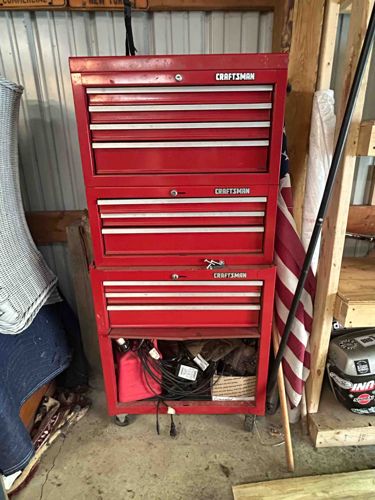
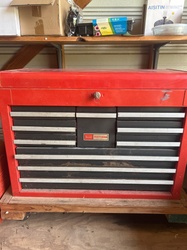
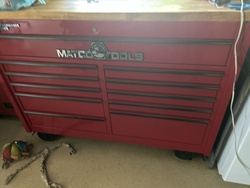
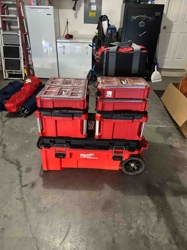
The item is a multi-part, stacked Craftsman tool chest system, predominantly colored in a vivid red. It consists of three primary sections: a top chest, a middle chest, and a rolling bottom cabinet. The entire unit appears to be constructed from sheet metal, likely steel, given its robust appearance. Each section features multiple drawers with silver-colored pull handles, indicating a combination of different drawer depths suitable for various tool sizes. The top chest has several narrow drawers, as does the middle section, while the bottom rolling cabinet also includes multiple drawers. The 'CRAFTSMAN' brand name is prominently displayed on the front of both the top and middle sections, utilizing white lettering against the red background, indicating its manufacturer. All three sections appear to have locking mechanisms, visible as keyholes on the front, suggesting security for stored tools. The bottom cabinet is equipped with four castor wheels, two of which are visible and appear to be swivel casters, indicating mobility. This bottom unit also features an open storage area at its base, below the lowest drawers, which is currently holding various items such as a red plastic container (possibly a gas can or funnel), tangled cables, and a cardboard box. The overall condition shows signs of use consistent with a workshop environment, including minor scuffs and surface dirt, but no significant dents or structural damage are immediately apparent. The paint finish seems largely intact, retaining its original vibrant red color. The design suggests a functional and durable tool storage solution, likely from the mid to late 20th century or early 21st century given the Craftsman branding style.
AI Appraisal Report
I have examined the provided image of the Craftsman Stackable Rolling Tool Chest. Based on my visual assessment, the item appears to be an authentic Craftsman product, readily identifiable by the distinct branding on the top and middle sections. The design is consistent with Craftsman's historical line of workshop storage solutions.
The overall condition of the tool chest is good, showing signs of typical use in a workshop environment—minor scuffs and surface dirt are visible, as expected. However, I observe no significant structural damage, major dents, or widespread paint loss. The vibrant red color remains largely intact, suggesting good care or robust original finish. The presence of all drawer pulls and visible locking mechanisms, along with what appear to be functional casters on the bottom unit, bodes well for its utility. The items stored in the bottom open area are ancillary and do not impact the core value of the chest itself.
In terms of market conditions, Craftsman tool chests are common and generally hold decent resale value due to their reputation for durability. While not rare, a complete, multi-part stackable system like this is more desirable than individual pieces. Demand for used tool storage is consistently moderate, particularly for well-known brands. Factors that significantly impact value include the brand's reputation, the overall condition (which is positive here), the completeness of the system, and its functionality (all drawers opening smoothly, locks working, casters rolling). The primary limitation in full authentication and precise valuation from an image alone is the inability to physically inspect the drawer mechanisms for smooth operation, test the locks, assess internal drawer condition, and check the integrity of the casters. An in-person examination would also reveal any hidden damage or repairs, and provenance documentation (e.g., original purchase receipts) could confirm its age, though this is less critical for a utilitarian item like a tool chest.