AI Appraisal Estimate

AI-generated estimates · not official valuations

From the user

What was submitted

Photo and notes provided by the user — not generated by AI

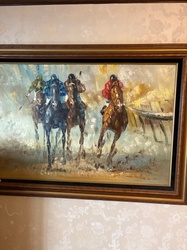
Submitted item photo
Submitted photo · June 8, 2026

User's notes

1920

AI analysis below

AI appraisal

AI analysis & estimate

AI-Generated · Verify before acting

Everything below is generated by AI for informational purposes only. AI can make mistakes — the AI may misidentify items or misattribute them (artist, maker, brand, designer, origin, era). This is not an official valuation and should not be used for insurance, sale, tax, estate, legal, or lending purposes — or any decision requiring a certified appraisal. It is not an authoritative claim about any person, brand, or rights holder — do not share or rely on it as a factual statement about a third party. Always consult qualified professionals before making financial decisions.

Note

This analysis also relies on unverified notes provided by the user, which may be incomplete or inaccurate and could affect the result.

Read the full disclaimer

AI Identification

·Not independently authenticated·Verify before acting

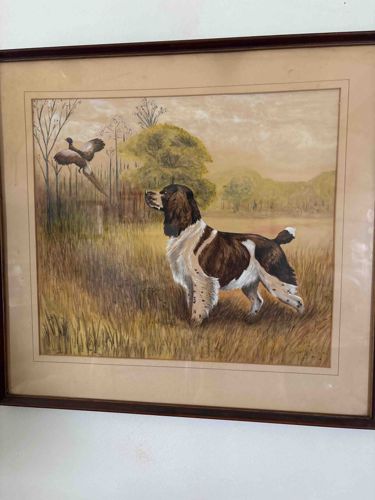
Early 20th Century Sporting Painting of a Springer Spaniel and Pheasant

Fine Art / Sporting Art Paintings

AI Estimated Value

·Not an official valuation·Verify before acting

$400.00 - $650.00

As of June 8, 2026

AI Item Analysis

·AI can make mistakes·Verify before acting
This is a framed original sporting artwork, likely a gouache or watercolor on paper, depicting a liver and white English Springer Spaniel in a field flushing a pheasant. The canine subject is rendered with fine detail, showing characteristic feathered fur and typical sporting breed markings. The background features a late-autumnal palette of ochres, browns, and muted greens, with skeletal trees and tall grasses suggestive of a hunting marsh or woodland edge. The composition is typical of the English Sporting Art style popular in the early 20th century, specifically the 1920s as indicated by the context provided. The artwork is housed in a simple dark wooden frame with a multi-layered cream mat. Notable condition issues include visible foxing and age-related yellowing (toning) across the paper, particularly in the sky area. There is some minor waving of the paper under the glass, indicating it may not be mounted to an acid-free board. The lack of a visible signature in this view suggests it could be an accomplished amateur work or that the signature is hidden by the mat. The craftsmanship is high, with excellent anatomical accuracy in the dog's posture and the pheasant's flight movement.
AI Appraisal Report

·AI can make mistakes·Verify before acting
I have examined the provided details for the sporting artwork depicting a Springer Spaniel and Pheasant, dated circa 1920. The piece displays the hallmark characteristics of the English Sporting Art tradition, featuring high anatomical precision in the canine subject and a dynamic sense of motion in the flushing pheasant. The use of gouache or watercolor is appropriate for the period, often favored for its quick-drying properties by artists capturing field scenes. Condition is a significant factor in this valuation. My visual inspection identifies widespread foxing (small brown spots) and significant toning/yellowing of the paper. These issues are indicative of long-term exposure to acidity, likely from a non-archival wood-pulp mat or backing board. The 'waving' suggests the paper is reacting to humidity without proper mounting. In the current market, collectors of sporting art prioritize condition; therefore, these conservation issues negatively impact the liquid value. The absence of a visible signature suggests the work is likely by a talented amateur or a 'circle of' student of established sporting artists like Thomas Blinks or Arthur Wardle. While the craftsmanship is excellent, unsigned works generally command lower price points at auction than known provincial masters. The market for Spaniel-themed art remains steady among hunting enthusiasts and breed collectors, though it has softened slightly from its peak in the early 2000s. Limitations: This appraisal is based on digital descriptions and cannot account for what may be hidden beneath the matting. A full authentication requires an in-person inspection to check for a signature along the paper edges, an examination of the paper's watermark, and a UV light test to identify any hidden repairs or overpainting. Provenance documenting the original purchase or previous collection history would be necessary to elevate the valuation to a higher tier.

Get your items appraised

Instant estimates of your treasures with AI-powered appraisals

Browse More Appraisals