AI estimate as of November 29, 2025 · verify with a professional before acting
AI-Generated · Verify before acting
Everything on this page is generated by AI for informational purposes only. AI can make mistakes — the AI may misidentify items or misattribute them (artist, maker, brand, designer, origin, era). This is not an official valuation and should not be used for insurance, sale, tax, estate, legal, or lending purposes — or any decision requiring a certified appraisal. It is not an authoritative claim about any person, brand, or rights holder — do not share or rely on it as a factual statement about a third party. Always consult qualified professionals before making financial decisions.
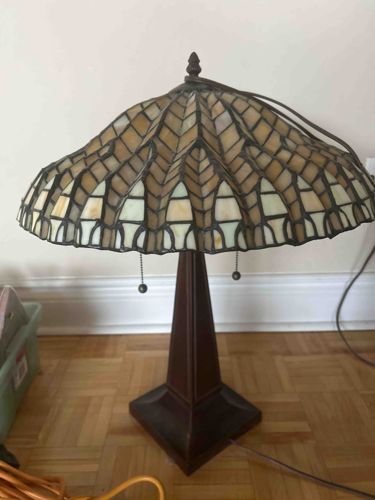
This is an Arts and Crafts style table lamp featuring a domed, multi-faceted stained glass shade and a substantial wooden base. The shade is constructed from numerous individual pieces of cut glass, primarily in shades of warm amber, light beige, and off-white/cream, creating a mosaic pattern. The patterns appear geometric, with a central section featuring a chevron or zig-zag array, transitioning to a border composed of arch-like or scalloped segments in lighter glass. The individual glass pieces are joined by dark solder lines, characteristic of Tiffany-style lamps, which also provide structural integrity and a distinctive aesthetic. The overall shape of the shade is reminiscent of an inverted bowl or mushroom cap, with a slight undulation along the lower rim. A dark metal finial crowns the apex of the shade. Two pull chains, each with a dark spherical or teardrop-shaped pull, are visible, indicating a dual-bulb socket system beneath the shade. The base of the lamp is made of dark-stained wood, possibly oak or mahogany, and features a sturdy square-shaped foot that tapers upwards into a columnar shaft with a subtle trapezoidal profile. The wood exhibits a smooth finish with visible grain, suggesting a solid construction. The lamp appears to be in good, used condition with a visible power cord extending from the base. There are no obvious signs of significant damage to the glass or the wooden base from the provided image, though minor wear consistent with age and use (e.g., slight patina on solder lines, minor scuffs on wood) would be typical for such an item. The craftsmanship appears to be of good quality, reflecting the traditional techniques associated with stained glass artistry. Its design suggests an early to mid-20th-century aesthetic, specifically aligning with the Arts and Crafts movement's emphasis on natural materials and handcrafted beauty.
AI Appraisal Report
I have examined the provided image of this Arts and Crafts style stained glass table lamp. Visually, the lamp appears to be in good, used condition. The stained glass shade, with its geometric amber and cream patterns, shows no obvious cracks or extensive damage, and the solder lines appear intact. The dark-stained wooden base also seems well-preserved, consistent with an item of its age. The design aesthetic, including the multi-faceted shade, dual pull chains, and substantial wooden base, strongly aligns with the Arts and Crafts movement, suggesting an early to mid-20th-century origin. This stylistic consistency points to it being an authentic period piece or a very well-executed reproduction.
Market conditions for Arts and Crafts lighting remain steady, with a consistent demand from collectors and decorators seeking period-appropriate pieces. Comparables for similar quality, non-Tiffany marked stained glass lamps with wooden bases typically range from $500 to $1,200, depending on the intricacy of the glasswork, overall condition, and provenance. The lack of a specific maker's mark (e.g., Tiffany Studios) prevents it from reaching higher values associated with premier manufacturers. While not exceedingly rare, a well-preserved example like this is sought after. The dual-bulb socket system is a positive feature, as is the robust wooden base.
Factors significantly impacting value include the visible quality of craftsmanship and the apparent good condition. However, it is crucial to note that this appraisal is based solely on visual examination of an image. Full authentication would require an in-person examination to verify the integrity of all solder joints, check for hidden hairline cracks, assess the electrical components for safety and originality, and inspect the wood for repairs or hidden damage. Examination for manufacturer's marks, assessment of glass type (opalescent vs. cathedral), and discussion of provenance documentation would also be necessary for a definitive appraisal.