These notes were written by the person who submitted this item. Appraiser.AI has not verified them, and the AI's identification and estimate may rely on them.
AI Estimated Value
Not an official valuation
$150-250
AI estimate as of August 21, 2025 · verify with a professional before acting
AI-Generated · Verify before acting
Everything on this page is generated by AI for informational purposes only. AI can make mistakes — the AI may misidentify items or misattribute them (artist, maker, brand, designer, origin, era). This is not an official valuation and should not be used for insurance, sale, tax, estate, legal, or lending purposes — or any decision requiring a certified appraisal. It is not an authoritative claim about any person, brand, or rights holder — do not share or rely on it as a factual statement about a third party. Always consult qualified professionals before making financial decisions.
This analysis also relies on unverified notes provided by the user, which may be incomplete or inaccurate and could affect the result.
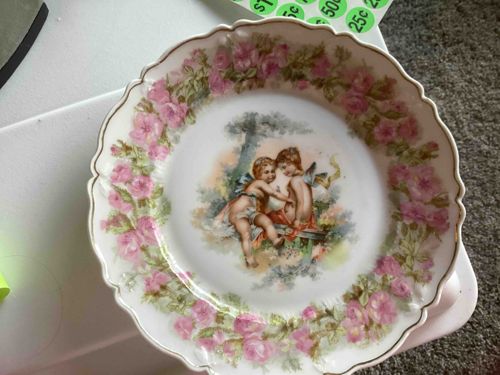
This is a vintage German-made decorative plate, likely crafted from porcelain or fine china, featuring a prominent central vignette of two cherubic figures, often referred to as putti or cupids. The cherubs are depicted in a classical, romantic style, suggesting an influence from Rococo or Neoclassical art. They appear to be engaged in an affectionate interaction, possibly playing or sharing a secret, set against a soft, muted landscape background with hints of greenery and sky. The plate's rim is adorned with a lush, continuous design of pink roses and green foliage, meticulously painted to create a sense of depth and volume. The edge of the plate is scalloped or fluted, adding to its ornate aesthetic, and is further outlined with a thin, gilded band, which shows some visible wear, consistent with age and handling. The overall color palette is delicate, with soft pinks, greens, and warm skin tones for the figures, contrasting with the bright white of the plate itself. No significant cracks or chips are immediately discernible from the image, but the gold trim shows some loss, which is a common condition issue for older decorative items with metallic accents. Given the style of artwork and the 'German made' context, this plate likely dates from the late 19th to early 20th century, a common period for detailed porcelain decorative wares. The craftsmanship appears to be of good quality, with fine brushstrokes visible in the floral and figural elements, indicative of skilled hand-painting.
AI Appraisal Report
Upon examining the provided image, this German porcelain decorative plate, featuring cherubs and roses, appears to be an authentic piece consistent with late 19th to early 20th-century European decorative arts. The hand-painted quality, particularly in the detailed floral work and figural elements, suggests skilled craftsmanship. The scalloped, gilded rim and rococo-influenced cherub motif are characteristic of the period and origin. Visually, the plate presents in good condition; there are no immediately discernible cracks or chips, which is a significant factor in maintaining value for porcelain. However, the loss of gilding on the rim is evident, a common and expected sign of age and handling, and it does slightly diminish the aesthetic appeal and thus, the overall value.
In terms of market conditions, decorative plates of this era, while charming, face moderate demand. The market for general antique porcelain can be somewhat selective, with stronger demand for pieces from renowned manufacturers (e.g., Meissen, KPM, Sevres) or those with unique artistic merit or historical significance. While this plate exhibits good quality, it doesn't appear to be from a top-tier identifiable maker from the image alone, which would significantly increase its rarity and value. Comparables in the current market for similar German decorative plates, without specific maker's marks or exceptional rarity, typically trade within a defined range. The cherub motif is popular, but not overly rare.
Factors significantly impacting value include the visible wear to the gilt, the absence of a clear maker's mark (which can only be confirmed by physical inspection of the underside), and the moderate demand for this specific type of decorative item. The overall aesthetic appeal and good preservation of the main artwork counterbalance the gilt loss.
Limitations in authenticity verification from images alone are crucial here. While the style and quality appear consistent with authentic German porcelain from the stated period, definitive authentication would require an in-person examination. This would allow for a thorough inspection of the plate’s integrity (e.g., micro-cracks, repairs not visible in photos), assessment of the porcelain body's quality, and, most importantly, the identification of a potential manufacturer's mark on the reverse. Provenance documentation (e.g., purchase receipts, family history) would also add to its verifiable authenticity and value. Scientific testing is generally not necessary for pieces of this nature unless there are strong suspicions of elaborate fakes, which is not indicated here.