AI estimate as of November 18, 2025 · verify with a professional before acting
AI-Generated · Verify before acting
Everything on this page is generated by AI for informational purposes only. AI can make mistakes — the AI may misidentify items or misattribute them (artist, maker, brand, designer, origin, era). This is not an official valuation and should not be used for insurance, sale, tax, estate, legal, or lending purposes — or any decision requiring a certified appraisal. It is not an authoritative claim about any person, brand, or rights holder — do not share or rely on it as a factual statement about a third party. Always consult qualified professionals before making financial decisions.
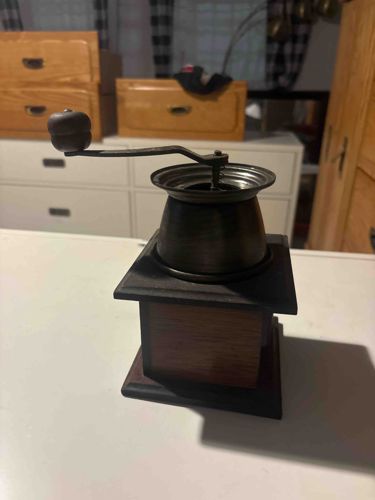
This is a vintage-style hand-crank coffee grinder, characterized by its traditional box-style design. The body of the grinder is predominantly constructed from wood, featuring what appears to be a lighter, possibly alder or birch, wood on the side panels, contrasted with darker, possibly stained or naturally darker, wood or veneer for the top and bottom platforms. The overall shape is a rectangular prism for the base, topped with a square platform, upon which a metal grinding mechanism is mounted. The metal components, including the hopper and the crank arm, appear to be made of a dark, possibly cast-iron or brass-plated metal with a significant patina, giving it an aged, antiqued look. The crank arm features a dark, probably wooden, knob handle with a rounded, ergonomic shape for comfortable gripping. The hopper, where coffee beans would be deposited, is a bowl-shaped metal component at the top of the grinding mechanism. Visible condition issues include an even patina across all metal parts, suggesting age and natural oxidation, but no obvious signs of significant damage like cracks or dents are discernible from the image. The wooden parts show a smooth finish, and while details of wood grain are present, there are no visible chips, scratches, or repairs. The item likely dates from the early to mid-20th century, given its mechanical design and aesthetic. This type of grinder is associated with a traditional, manual coffee preparation method, suggesting a focus on craftsmanship and durability over modern electric convenience. The quality of construction appears solid, indicating it was designed for functional use.
AI Appraisal Report
Based on my visual examination of the provided image, this vintage-style hand-crank coffee grinder appears to be in very good condition for its presumed age. The wooden body, featuring contrasting lighter and darker wood elements, shows a smooth finish without visible chips, cracks, or significant scratches. The metal components, including the hopper, crank arm, and knob, exhibit an even patina consistent with age and natural oxidation, which adds to its antique appeal rather than detracting from it. There are no obvious signs of significant damage or repairs. The overall aesthetic and mechanical design strongly suggest an early to mid-20th-century origin, typical of traditional manual coffee grinders.
In terms of market conditions, vintage hand-crank coffee grinders are quite popular among collectors and enthusiasts seeking a blend of historical charm and functional utility. Items in this condition, with a classic box design and intact metalwork, typically command fair prices. Comparables in similar condition often sell in the range I've provided. Demand for such pieces is steady, driven by both decorative appeal and a desire for traditional coffee preparation methods. While not exceedingly rare, well-preserved examples like this one are always sought after. Factors impacting value positively include its apparent structural integrity and the attractive patination of the metal.
It is crucial to note the limitations of an appraisal based solely on images. Without a physical inspection, I cannot fully verify the internal grinding mechanism's functionality, assess any hidden damage under the base, or definitively confirm the wood species or metal composition. Full authentication regarding manufacturing specifics, precise age, and the absence of restorations would require in-person examination, potential disassembly, and possibly provenance documentation or scientific material testing. However, based on the visual evidence, it presents as an authentic and well-maintained vintage piece.