AI estimate as of July 25, 2026 · verify with a professional before acting
AI-Generated · Verify before acting
Everything on this page is generated by AI for informational purposes only. AI can make mistakes — the AI may misidentify items or misattribute them (artist, maker, brand, designer, origin, era). This is not an official valuation and should not be used for insurance, sale, tax, estate, legal, or lending purposes — or any decision requiring a certified appraisal. It is not an authoritative claim about any person, brand, or rights holder — do not share or rely on it as a factual statement about a third party. Always consult qualified professionals before making financial decisions.
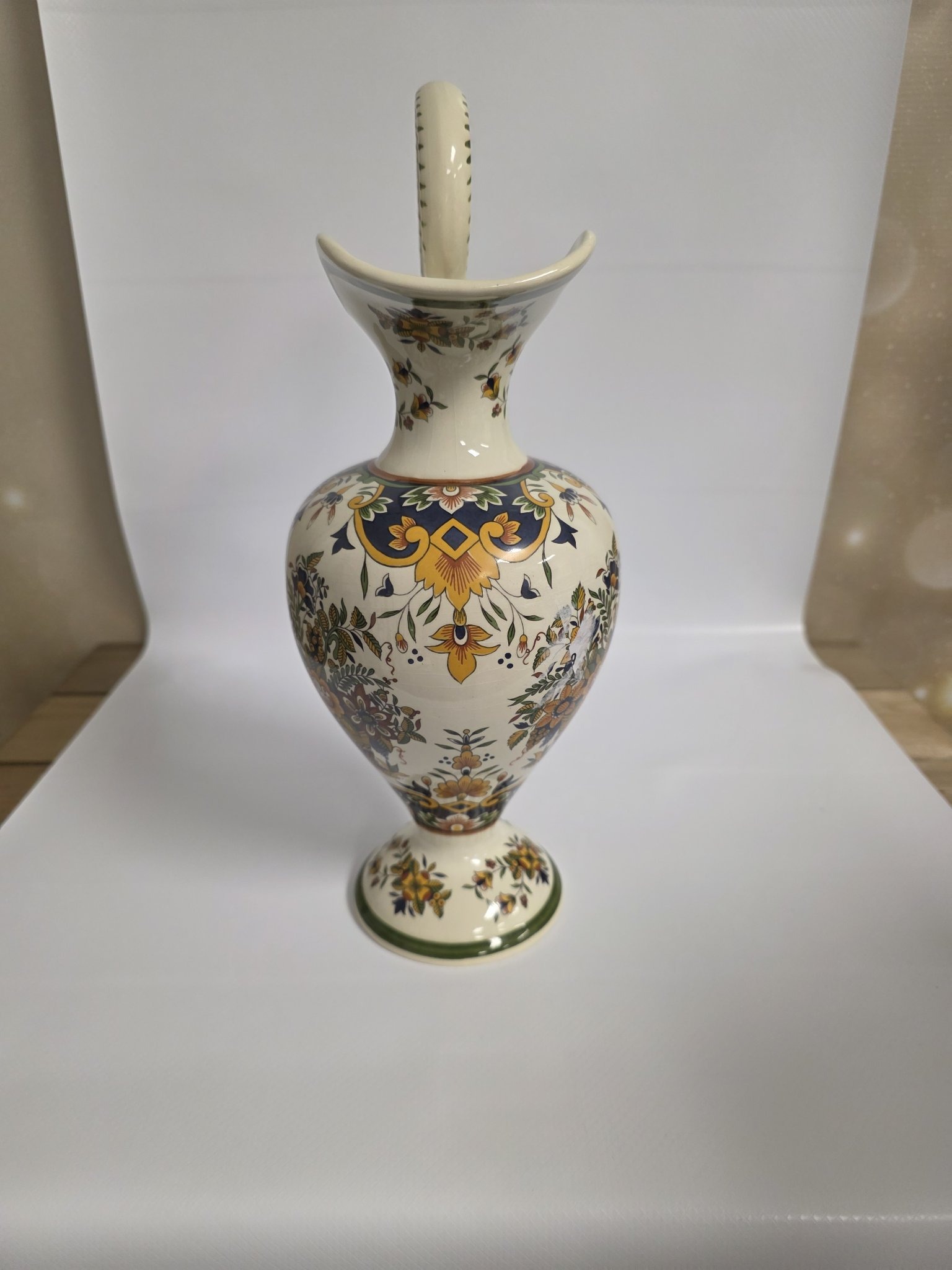
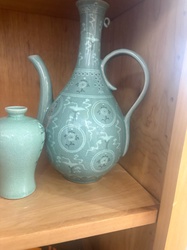
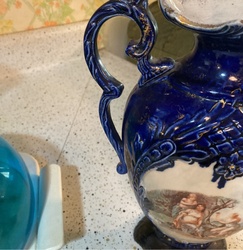
This ceramic pitcher-style vase features an ornate hand-painted polychrome design over a light cream-colored glazed ground. The piece exhibits an amphora-like baluster body supported by a circular pedestal foot, an elongated neck with a pinched, flared rim, and a single vertical loop handle. The decoration consists of elaborate floral scrolls, palmettes, and geometric motifs in shades of cobalt blue, mustard yellow, terracotta brown, olive green, and soft blue. The rim, base, and handle are highlighted with dark green trim and delicate floral accents. The smooth, glossy glazed finish appears consistent with traditional earthenware or majolica/faience production. No maker's marks, signatures, or backstamps are visible from this frontal angle, so specific attribution to a regional factory—such as Italian Deruta, French Rouen, or Spanish Talavera traditions—remains a hypothesis subject to in-person inspection of the base. The piece appears to be in very good vintage or modern reproduction condition with minor surface reflections and no immediately visible chips, cracks, or structural restoration.
AI Appraisal Report
Based on the provided image, I have examined this ceramic pitcher-style vase featuring hand-painted polychrome decoration in the Majolica or tin-glazed faience tradition. The piece displays a baluster body, flared rim, and ornate floral scrolling in cobalt blue, mustard yellow, and terracotta tones. From what I can see, the glaze exhibits a high gloss with no obvious major chips, cracks, or visible repairs, suggesting very good condition.
However, there are inherent limitations to evaluating ceramics solely from a photograph. I cannot verify the physical weight, glaze texture, or presence of faint craze lines. Crucially, the base is not visible, preventing the examination of potential factory marks, painted initials, or glaze-free foot rings that typically aid in regional attribution—whether Italian (Deruta), French (Rouen/Nevers), Spanish (Talavera), or a modern studio reproduction.
Assuming this piece is an authentic late 19th to mid-20th century European faience or Majolica vessel in good condition, I estimate its value in the $100 to $250 range. Decorative earthenware of this style maintains steady decorative appeal, though the secondary market favors fully documented, factory-marked examples.
Should an in-person examination, hallmark verification, or provenance documentation indicate this is a contemporary, mass-produced reproduction or a lower-quality decorative copy 'in the style of' traditional Majolica, the fair market value would likely decrease to approximately $30 to $60. To firmly establish origin, age, and value, a physical inspection by a ceramics specialist is recommended.