AI estimate as of July 10, 2025 · verify with a professional before acting
AI-Generated · Verify before acting
Everything on this page is generated by AI for informational purposes only. AI can make mistakes — the AI may misidentify items or misattribute them (artist, maker, brand, designer, origin, era). This is not an official valuation and should not be used for insurance, sale, tax, estate, legal, or lending purposes — or any decision requiring a certified appraisal. It is not an authoritative claim about any person, brand, or rights holder — do not share or rely on it as a factual statement about a third party. Always consult qualified professionals before making financial decisions.
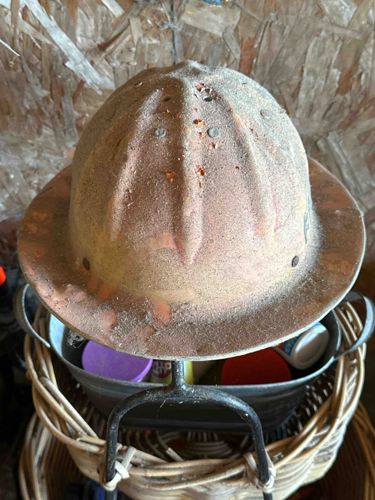
The item is a very heavily soiled and worn construction hard hat, likely made from a resin-impregnated fiber or early plastic material, characteristic of hard hats from the mid-20th century. Its color appears to have once been orange, though it is now largely obscured by a thick layer of reddish-brown dust, dirt, and possibly rust particles, indicating prolonged storage in a dusty or industrial environment. The hard hat features a ribbed crown design, with several prominent, evenly spaced ridges running from the top center down towards the brim, which would have added structural integrity. Numerous small, circular metal rivets or fasteners are visible across the crown, appearing to secure an internal suspension system, which is not visible here. Some of these fasteners show clear signs of corrosion. There are also several small holes or perforations on the top surface, possibly for ventilation or additional attachment points, though some may also be signs of impact damage or material degradation. The brim is relatively wide, offering protection to the face and neck. The overall condition suggests heavy use and neglect, with significant surface abrasion, discoloration, and a thick, uneven patina of dirt. No clear manufacturer's marks or specific dates are discernible due to the extensive soiling and wear, but its construction and apparent materials suggest it could date from the 1950s to 1970s. The craftsmanship, while once industrial standard, is now overshadowed by its deteriorated state, making it more of a historical artifact of occupational safety wear than a functional piece.
AI Appraisal Report
Based on my visual examination of the provided image, this Vintage Industrial Hard Hat appears to be a genuine artifact from the mid-20th century, likely dating from the 1950s to 1970s, as indicated by its ribbed crown design, apparent resin-impregnated fiber or early plastic material, and visible metal rivets. Its extremely heavily soiled and worn condition, while detracting from aesthetic appeal, contributes to its authenticity as a discarded occupational safety item rather than a replica. The thick layer of reddish-brown dirt and potential rust particles, coupled with surface abrasion and discoloration, suggests extensive use and prolonged exposure to harsh industrial environments.
The market for vintage industrial safety equipment is niche, driven primarily by collectors of occupational memorabilia, industrial history enthusiasts, or those seeking unique decorative items for industrial-themed decor. While comparable items in better condition or with discernible manufacturer's marks might fetch higher prices (e.g., specific MSA or E.D. Bullard models that are well-documented), the extreme state of disrepair and lack of identifying features significantly limit its market value. Demand is moderate, but rarity for such a generic, heavily deteriorated hard hat is low, as countless similar items were produced. Factors significantly impacting its value negatively include its poor condition, the absence of any visible branding or specific model identification, and the unclear material composition without direct handling.
Limitations in authenticity verification from images alone are significant. I cannot definitively confirm the material (e.g., early plastic vs. fiber without handling), nor can I ascertain the presence of any hidden markings. Full authentication would require in-person examination to inspect manufacturer's stamps, material composition, and the method of suspension system attachment. Provenance documentation, such as records of its use or origin, would greatly enhance its historical value. Scientific testing of the material could also confirm its age and composition.