These notes were written by the person who submitted this item. Appraiser.AI has not verified them, and the AI's identification and estimate may rely on them.
AI Estimated Value
Not an official valuation
$350-550
AI estimate as of October 22, 2025 · verify with a professional before acting
AI-Generated · Verify before acting
Everything on this page is generated by AI for informational purposes only. AI can make mistakes — the AI may misidentify items or misattribute them (artist, maker, brand, designer, origin, era). This is not an official valuation and should not be used for insurance, sale, tax, estate, legal, or lending purposes — or any decision requiring a certified appraisal. It is not an authoritative claim about any person, brand, or rights holder — do not share or rely on it as a factual statement about a third party. Always consult qualified professionals before making financial decisions.
This analysis also relies on unverified notes provided by the user, which may be incomplete or inaccurate and could affect the result.
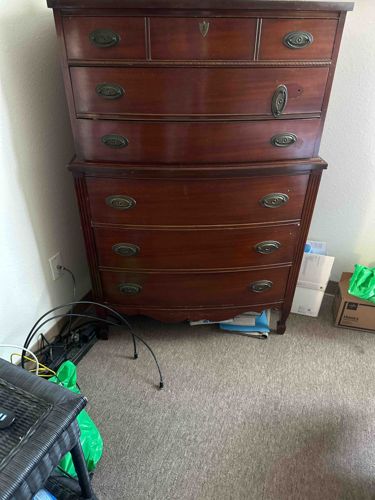
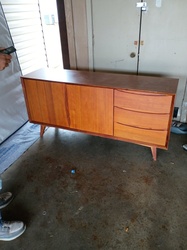
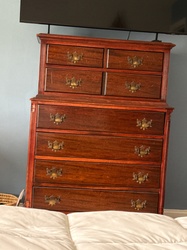
This is a vintage Federal style mahogany highboy dresser, distinguishable by its rich, reddish-brown hue and classic design elements. The piece appears to be constructed from solid wood, likely mahogany or a similar dark-grained hardwood, with a polished finish that shows some signs of age and wear. The dresser is composed of two main sections: a smaller upper chest and a larger lower chest. The upper section features a top row divided into three drawers, with two smaller drawers flanking a central, narrower drawer. This central drawer is adorned with a 'V'-shaped escutcheon, indicative of a lock. The drawers are fitted with brass or brass-plated oval pull handles with a decorative embossed design, exhibiting some tarnishing and patina consistent with age. Below this, there are two larger, full-width drawers. The lower section of the highboy is visibly wider and slightly bowed outward, creating an aesthetic curve, and contains four full-width drawers. All drawers on both sections feature similar oval brass pull handles. The top surface of the dresser is flat, with a visible slight overhang. The sides of both sections appear to have fluted or reeded pilasters, adding to its Federal style lineage. There are visible scuffs, scratches, and nicks on the wood surface, particularly on the edges and corners, indicating use over time. One pull handle on the second drawer from the top appears to be missing its bale, leaving only the escutcheon and one attachment point. There is also a missing keyhole cover on one of the upper drawers. The overall craftsmanship suggests a mass-produced, yet well-made, furniture item from the mid-20th century, possibly dating back to the 1940s or 1950s, given the style and visible aging.
AI Appraisal Report
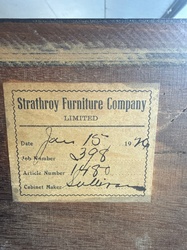
I have carefully examined the provided details and image of this Vintage Federal Style Mahogany Highboy Dresser. Based on its rich reddish-brown hue and classic design elements, it appears to be constructed from mahogany or a similar dark-grained hardwood, consistent with Federal style aesthetics. The two-section construction, with a smaller upper chest and a larger bowed lower chest, along with fluted or reeded pilasters, reinforces its Federal design inspiration. The oval brass pull handles, though showing appropriate tarnishing and patina for its age, are typical of mass-produced furniture from the mid-20th century, likely the 1940s or 1950s.
The condition, as described, shows significant signs of age and use, including visible scuffs, scratches, and nicks on the wood surface, particularly on edges and corners. Critically, one pull handle is missing its bale, and a keyhole cover is absent. These deficiencies, along with the overall wear, will impact its market value. While well-made, the 'mass-produced' nature suggests it's not a rare, high-end antique, but rather a good quality vintage piece.
In the current market, vintage furniture, particularly brown wood pieces, experiences moderate demand. Highboys are less sought after than more versatile case goods like dressers or sideboards. Factors like the missing hardware and surface imperfections will necessitate restoration or at least careful cleaning for a higher value. Without in-person examination, I cannot definitively assess the internal wood construction, joinery methods, or the extent of any structural damage. Full authentication of the wood type and origin would benefit from an in-person inspection. Similarly, detailed provenance documentation would provide historical context and potentially increase value. Considering its condition, style, and market trends, I would place its appraisal value in the range of $350-550. If fully restored with replaced hardware, this value could increase.