AI estimate as of July 17, 2025 · verify with a professional before acting
AI-Generated · Verify before acting
Everything on this page is generated by AI for informational purposes only. AI can make mistakes — the AI may misidentify items or misattribute them (artist, maker, brand, designer, origin, era). This is not an official valuation and should not be used for insurance, sale, tax, estate, legal, or lending purposes — or any decision requiring a certified appraisal. It is not an authoritative claim about any person, brand, or rights holder — do not share or rely on it as a factual statement about a third party. Always consult qualified professionals before making financial decisions.
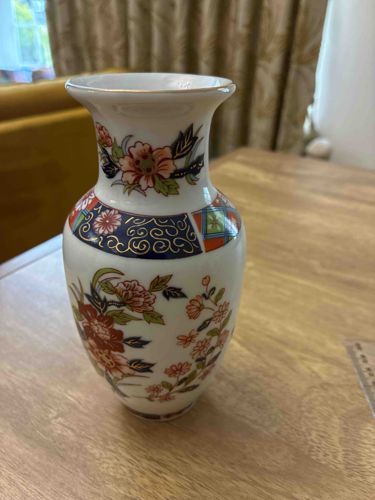
This is a small decorative porcelain vase, likely of Japanese or East Asian origin, exhibiting a traditional Imari-style floral pattern. The vase stands approximately 6-8 inches tall, with a classic baluster form, featuring a flared rim, a slender neck, broadening shoulders, and a tapering body that narrows towards the base. The primary material is white glazed ceramic or porcelain, giving it a smooth, glossy finish. The decorative scheme is quite intricate, utilizing a rich palette of colors including cobalt blue, iron red (rust), green, and hints of orange and gold.
Observable features include a main band of dark blue with elaborate gold scrolling or cloud motifs encircling the upper part of the body, just below the neck. Above and below this band, and extending down the body, are various floral arrangements. These flowers, possibly chrysanthemums, peonies, or cherry blossoms, are rendered in shades of red, pink, and orange with green leaves and black accents, depicting a naturalistic yet stylized representation. The rim of the vase is delicately lined with a gold band, indicative of a finer quality finish. The overall condition appears good with no immediately visible chips, cracks, or significant wear to the glaze, though minor surface abrasions or slight loss to the gold accents would require closer inspection. The craftsmanship suggests a commercially produced item, possibly from the mid to late 20th century, imitating popular antique Japanese porcelain styles. The intricate detailing and vibrant color application indicate a reasonable level of skill in its manufacture, designed for aesthetic appeal rather than utilitarian function.
AI Appraisal Report
Upon examining the provided image of this Imari-style porcelain floral vase, my initial assessment of its condition is good. I observe no obvious chips, cracks, or significant glaze loss. The gold accents appear largely intact, though closer in-person inspection would be needed to detect minor abrasions or subtle wear, which are common for pieces of this nature.
Authenticity, based solely on visual cues from an image, is limited. While it clearly mimics the traditional Imari aesthetic, the description suggests a commercially produced item from the mid to late 20th century. This aligns with the generally well-preserved condition and the consistent application of decoration, which often characterizes mass-produced pieces of that era rather than earlier, more artisanal examples. Without a physical kiln mark, maker's mark, or provenance documentation, definitively authenticating it as a specific period piece or from a particular renowned workshop is impossible.
In terms of market conditions, there is consistent demand for decorative porcelain, particularly pieces styled after recognizable traditions like Imari. However, the market is saturated with later reproductions. Comparable items of similar quality and age (mid-late 20th century reproductions) typically fetch modest prices. Therefore, rarity is not a significant factor here; these are widely available.
The primary factors impacting value are its good condition and pleasing aesthetic. If it were genuinely an antique Imari piece (18th or 19th century) or by a renowned modern artisan, its value would be considerably higher. However, its likely origin as a commercially produced reproduction limits its investment appeal.
For full authentication, a hands-on examination is crucial to assess the porcelain's weight, feel, and the precise application of glazes and enamels, which can reveal production methods. Examination under UV light can detect repairs or professional restoration. Provenance documentation, such as original purchase receipts or family records, would also significantly aid in confirming its age and origin. Scientific testing, like X-ray fluorescence (XRF) to analyze paint compositions, could provide definitive insights into the age of the materials used.