AI estimate as of November 17, 2025 · verify with a professional before acting
AI-Generated · Verify before acting
Everything on this page is generated by AI for informational purposes only. AI can make mistakes — the AI may misidentify items or misattribute them (artist, maker, brand, designer, origin, era). This is not an official valuation and should not be used for insurance, sale, tax, estate, legal, or lending purposes — or any decision requiring a certified appraisal. It is not an authoritative claim about any person, brand, or rights holder — do not share or rely on it as a factual statement about a third party. Always consult qualified professionals before making financial decisions.
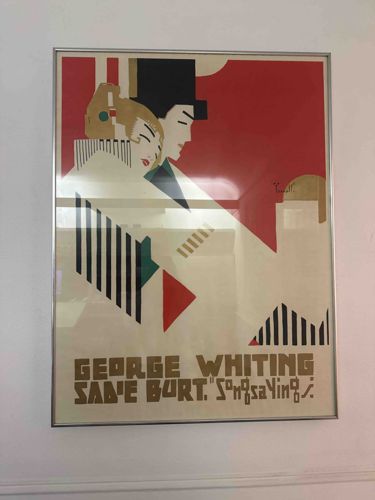
This item is a framed Art Deco style poster advertising 'George Whiting and Sadie Burt. "Songs a' Saying"'. The poster features a striking graphic design characteristic of the Art Deco period, dominated by clean lines, geometric shapes, and a limited, yet bold, color palette. The central imagery depicts a stylized profile of a man and a woman. The man, on the right, wears a black top hat, and the woman, on the left, has blonde hair styled in a bob and wears a prominent green circular earring. Both figures are rendered with minimalist features, emphasizing their silhouettes and angular forms. The background is a vibrant red to the right, transitioning to a light cream or off-white on the left and bottom. Geometric elements, including black and white diagonal stripes, red triangles, and gold accents, are integrated throughout the composition, suggesting movement and rhythm. The typography for the title 'GEORGE WHITING SADIE BURT. "Songs a' Saying"' is a blocky, stylized font in a gold or brown color, fitting the period's aesthetic preference for strong, decorative typefaces. A subtle signature, possibly 'Truell' or similar, is visible in the upper right quadrant of the red background. The poster is housed in a simple, slender silver-colored metal frame, which appears to be a modern addition, protecting it behind glass or acrylic. There are no immediately obvious condition issues from the provided image, such as tears, significant creases, or water damage, though a detailed inspection out of the frame would be needed to confirm. The vibrant colors appear well-preserved under what looks like protective glazing, and the paper itself doesn't show overt signs of discoloration. The Art Deco style and the nature of the advertising suggest an estimated age from the 1920s to 1930s. The craftsmanship is indicative of commercial poster art of that era, prioritizing visual impact and clear communication through artistic design.
AI Appraisal Report
I have examined the image of this framed Art Deco poster advertising 'George Whiting and Sadie Burt. "Songs a' Saying"'. The visual appeal is strong, characteristic of the Art Deco period with its bold geometric forms, striking color palette (red, cream, black, gold), and stylized figures. The typography is period-appropriate, enhancing its vintage charm. From the image, the poster appears to be in very good condition; colors are vibrant, and I don't observe any overt signs of significant tears, creases, or discoloration usually associated with age or poor handling. The modern silver-colored frame and glazing likely contribute to its preservation and presentation. A subtle signature, possibly 'Truell', in the upper right quadrant, could denote the original artist.
From a market perspective, original Art Deco advertising posters, especially those with strong graphic content for entertainment or cultural events, consistently command good prices. Similar posters by known artists from the 1920s-1930s, particularly those in good condition, have realized values in this range. The clear visual communication and aesthetic quality make it desirable. Its rarity would depend on the print run, but posters for specific performers during that era are generally not mass-produced like commercial product ads. The main factor impacting value positively is its iconic Art Deco design and apparent excellent condition.
However, it is crucial to note the limitations of appraising from an image alone. While the visible condition is excellent, the authenticity of the print itself (e.g., whether it's an original lithograph or a later reproduction) cannot be definitively determined without an in-person examination. Physical inspection would allow me to assess the paper quality, printing technique, and any subtle condition issues not visible through the frame or in the photograph. Furthermore, provenance documentation would be invaluable to confirm its history and originality. Scientific testing might confirm paper age and pigment composition, but this is usually reserved for higher-value pieces or if authenticity is strongly questioned.