AI estimate as of November 8, 2025 · verify with a professional before acting
AI-Generated · Verify before acting
Everything on this page is generated by AI for informational purposes only. AI can make mistakes — the AI may misidentify items or misattribute them (artist, maker, brand, designer, origin, era). This is not an official valuation and should not be used for insurance, sale, tax, estate, legal, or lending purposes — or any decision requiring a certified appraisal. It is not an authoritative claim about any person, brand, or rights holder — do not share or rely on it as a factual statement about a third party. Always consult qualified professionals before making financial decisions.
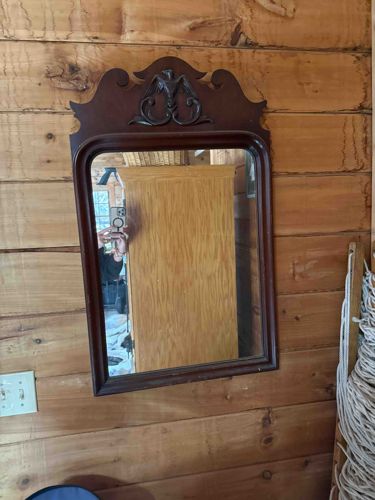
This is a Victorian-style wall mirror, likely from the late 19th or early 20th century. The frame is constructed from a dark-stained wood, possibly mahogany or walnut, given its rich, deep brown hue, and features a classic rectangular form with a distinctively ornate crest at the top. The upper crest is an integral part of the frame, showcasing a pierced and carved design with symmetrical scrolls and a central foliate motif. This carving adds a decorative flourish common in Victorian aesthetics. The mirror glass itself appears to be in good condition with no visible cracks or significant silvering loss, reflecting the surrounding rustic wooden wall and a piece of wooden furniture. The frame's finish exhibits a natural patina consistent with age, and there are no immediately obvious signs of major damage such as chips or breaks, though a closer inspection might reveal minor surface scratches or wear. The craftsmanship appears to be of good quality, with attention paid to the carving details. The edges of the rectangular mirror portion are slightly rounded or beveled, adding to the refined appearance. This piece would have originally functioned as a decorative and practical item in a home, reflecting light and adding visual interest to a room. Its construction suggests it was designed to be hung on a wall.
AI Appraisal Report
This Victorian-style wall mirror, likely dating from the late 19th to early 20th century, presents as a well-preserved example of its period. The dark-stained wood frame, possibly mahogany or walnut, displays an attractive patina consistent with age. The ornate carved crest, featuring symmetrical scrolls and a central foliate motif, is characteristic of Victorian aesthetics and appears to be in good, unbroken condition. The mirror glass itself shows no obvious cracks or significant silvering loss from the image provided. While I can assess the overall condition as good and the craftsmanship as solid based on visual cues, a full assessment would require in-person examination to detect minor surface scratches, veneer issues, or repairs not visible in the photograph.
From a market perspective, Victorian mirrors with attractive carving remain desirable, though the demand for highly ornate pieces has moderated. Comparables suggest that mirrors of this style and condition typically fall within the $300-$500 range, especially when the wood type isn't definitively identified as a premium timber like solid mahogany. Factors impacting value positively include the seemingly original and well-maintained condition of both the frame and glass, and the pleasing design of the crest. Conversely, the lack of specific provenance, maker's marks, or a historically significant origin limits its upper value potential.
Authenticity, in terms of its age and style, appears credible from the visual evidence. However, to definitively confirm the wood type, age, and rule out modern reproductions or significant restorations not apparent, an in-person examination is crucial. This would allow for close inspection of joinery, finish integrity, and tool marks. Scientific testing, such as wood analysis, would also solidify authenticity. Without physical inspection, I cannot confirm the full extent of any repairs or the precise material composition.