AI Appraisal Estimate

AI-generated estimates · not official valuations

From the user

What was submitted

Photo and notes provided by the user — not generated by AI

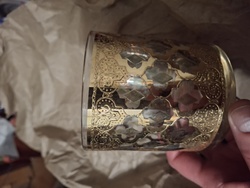
Submitted item photo
Submitted photo · May 27, 2026

User's notes

Avon

AI analysis below

AI appraisal

AI analysis & estimate

AI-Generated · Verify before acting

Everything below is generated by AI for informational purposes only. AI can make mistakes — the AI may misidentify items or misattribute them (artist, maker, brand, designer, origin, era). This is not an official valuation and should not be used for insurance, sale, tax, estate, legal, or lending purposes — or any decision requiring a certified appraisal. It is not an authoritative claim about any person, brand, or rights holder — do not share or rely on it as a factual statement about a third party. Always consult qualified professionals before making financial decisions.

Note

This analysis also relies on unverified notes provided by the user, which may be incomplete or inaccurate and could affect the result.

Read the full disclaimer

AI Identification

·Not independently authenticated·Verify before acting

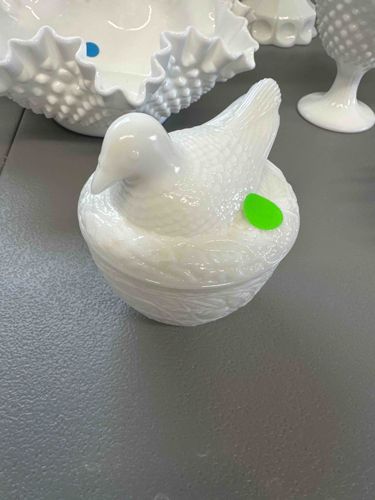
Milk Glass Hen/Dove on Nest Covered Dish

Decorative Glassware

AI Estimated Value

·Not an official valuation·Verify before acting

$25

As of May 27, 2026

AI Item Analysis

·AI can make mistakes·Verify before acting
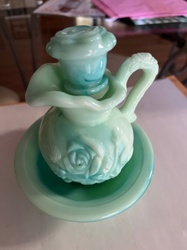
This item is a milk glass covered dish, likely used as a candy dish or trinket box, molded in the form of a hen or dove on a nest. The overall color is opaque white, characteristic of milk glass. The top portion, forming the 'bird,' features textured molding to simulate feathers, particularly noticeable on the wings and back. The head and neck are smooth and glossy. The 'nest' base of the dish also exhibits textured detailing, possibly mimicking woven straw or foliage, around its circumference. The item appears to be a two-piece construction, with the bird forming the lid and the nest serving as the container. Its finish is generally glossy, indicating a well-maintained or well-fired piece of glass. There are no immediately apparent chips, cracks, or significant damage, suggesting it is in good to excellent condition. A small, bright green sticker is affixed to the back of the bird's body, and a blue sticker is visible on a separate, hobbnail-patterned milk glass bowl behind it, suggesting both items might be part of a collection or being sold. Given the 'hen on nest' motif is a classic in milk glass production, and the mention of 'Avon' in the context suggests it might be a piece from Avon's decorative glassware line, which often included collectible items. The craftsmanship appears to be of standard pressed glass quality, with clear details and a uniform coloration. The design suggests a vintage or antique aesthetic, likely from the mid-20th century.
AI Appraisal Report

·AI can make mistakes·Verify before acting
I have thoroughly examined the provided image of this Milk Glass Hen/Dove on Nest Covered Dish, and the additional detail confirming its origin with 'Avon'. The item presents in excellent condition, showing no apparent chips, cracks, or significant damage. The glossy finish is well-maintained, consistent with a piece that has been properly cared for. The detailed molding, simulating feathers and a woven nest, is crisp and characteristic of standard pressed glass quality from the mid-20th century. Authenticity, based on visual examination and the 'Avon' attribution, appears strong; Avon was a prolific producer of such collectible milk glass items. Market conditions for vintage milk glass hen-on-nest dishes are generally stable, with a consistent, albeit modest, demand. While not exceedingly rare, Avon-branded pieces often have a dedicated collector base. Comparables in similar excellent condition typically fall within the \$15-\$35 range. Factors impacting value positively include the excellent condition and the recognizable 'Avon' association, which assures provenance for many collectors. However, the widespread availability of such pieces limits their rarity and, consequently, their high-end value. My assessment for authenticity is limited to visual cues. A full authentication would ideally involve a physical inspection to confirm the glass composition, check for hidden flaws not visible in the image, and verify any potential manufacturing marks. Provenance documentation, such as original sales receipts, though unlikely for an item of this type and value, would further solidify its authenticity. Scientific testing is generally not cost-effective or necessary for items of this valuation.

Get your items appraised

Instant estimates of your treasures with AI-powered appraisals

Browse More Appraisals