AI Appraisal Estimate

AI-generated estimates · not official valuations

From the user

What was submitted

Photo and notes provided by the user — not generated by AI

Submitted item photo
Submitted photo · June 4, 2026

User's notes

No additional notes provided.

AI analysis below

AI appraisal

AI analysis & estimate

AI-Generated · Verify before acting

Everything below is generated by AI for informational purposes only. AI can make mistakes — the AI may misidentify items or misattribute them (artist, maker, brand, designer, origin, era). This is not an official valuation and should not be used for insurance, sale, tax, estate, legal, or lending purposes — or any decision requiring a certified appraisal. It is not an authoritative claim about any person, brand, or rights holder — do not share or rely on it as a factual statement about a third party. Always consult qualified professionals before making financial decisions.

Read the full disclaimer

AI Identification

·Not independently authenticated·Verify before acting

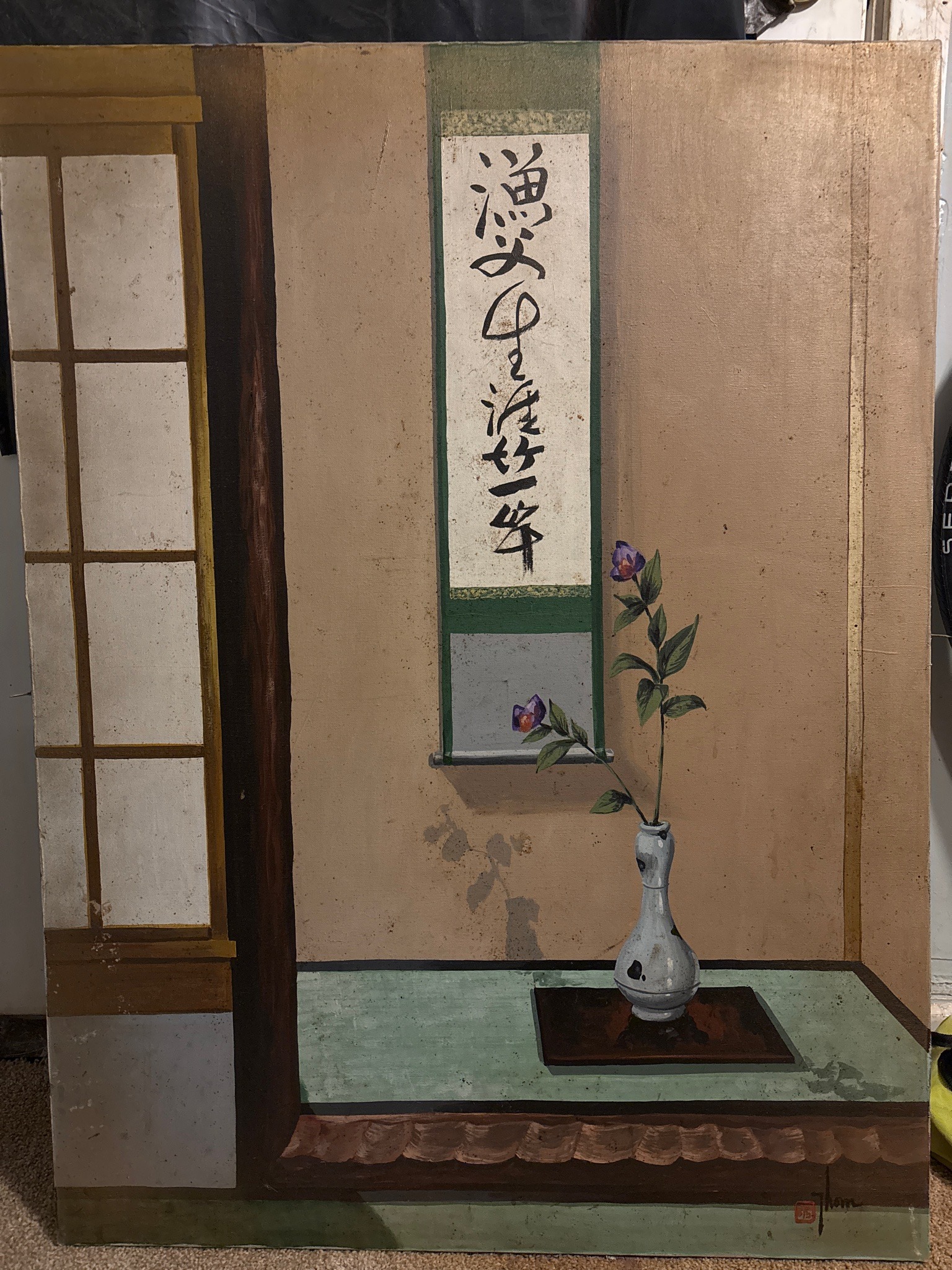
Mid-to-late 20th-century interior still life painting, attributed to Thom

Fine Art Paintings

AI Estimated Value

·Not an official valuation·Verify before acting

$400 - $700

As of June 4, 2026

AI Item Analysis

·AI can make mistakes·Verify before acting
This is a vertically oriented representational painting on canvas, likely oil or acrylic, depicting a Japanese-influenced interior scene. The composition features a still life of a single floral arrangement in a white ceramic vase resting on a low wooden base, positioned before a wall hanging (kakemono) with cursive black calligraphy. To the left, a vertical shoji screen is partially visible. The color palette is composed of muted earth tones, tans, and pale greens. The work bears a signature in the lower right corner that appears to read 'Thom' in cursive, accompanied by a small red square seal or 'chop', stylistically consistent with 20th-century Western artists working in an Orientalist or Japonisme style. The application of paint appears flat with some visible texture on the canvas. The age is subject to verification but is stylistically consistent with the mid-to-late 20th century. There are visible condition issues, including scattered dark spotting or staining on the tan wall area, particularly just to the left of the vase, and Some edge wear and minor surface abrasions consistent with age and handling. Without a physical inspection or a clear provenance record, this attribution to an artist named 'Thom' remains a hypothesis based on the visible signature and seal.


AI Appraisal Report

·AI can make mistakes·Verify before acting
I have examined the image provided of this interior still life painting. Based on what I can see, the work bears a signature in the lower right consistent with 'Thom' and features a red seal or 'chop' common in 20th-century Japonisme. However, I cannot verify from a photo whether the signature and seal are contemporary with the paint application or added later. The value of $400 - $700 is based on the assumption that this attribution to 'Thom' is a correct working hypothesis, as the style and execution align with mid-to-late 20th-century decorative fine art. The composition shows significant skill in its minimalist arrangement and muted palette, though I must note visible condition issues including dark staining or spotting on the tan wall section and minor edge abrasions. These factors negatively impact the marketability and value. In the current market, there is moderate demand for mid-century works with East Asian motifs, though this demand relies heavily on the quality of execution and the artist's identity. If a physical inspection or provenance documentation were to show this is a later copy or merely 'in the style of' the artist, the value would likely drop to the $100 - $200 range as a decorative object. To confirm this appraisal, an in-person examination by a conservator is needed to assess the canvas age and chemical composition of the pigments. A higher value would require verifiable provenance or a record of exhibition. Without these, the attribution remains a hypothesis, and the estimate reflects the item's appeal as an unauthenticated decorative work of its period and style. Physical inspection is also required to determine if the spotting is surface dirt or mold.

Get your items appraised

Instant estimates of your treasures with AI-powered appraisals

Browse More Appraisals