AI estimate as of July 19, 2025 · verify with a professional before acting
AI-Generated · Verify before acting
Everything on this page is generated by AI for informational purposes only. AI can make mistakes — the AI may misidentify items or misattribute them (artist, maker, brand, designer, origin, era). This is not an official valuation and should not be used for insurance, sale, tax, estate, legal, or lending purposes — or any decision requiring a certified appraisal. It is not an authoritative claim about any person, brand, or rights holder — do not share or rely on it as a factual statement about a third party. Always consult qualified professionals before making financial decisions.
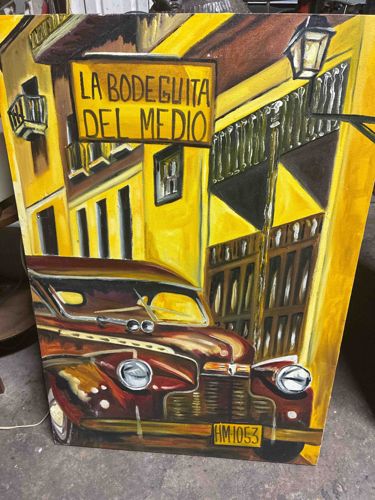
This is an oil painting on canvas or a similar two-dimensional surface, depicting a vibrant street scene, likely in Havana, Cuba, given the iconic 'La Bodeguita del Medio' sign prominently featured. The painting employs a bold color palette dominated by warm yellows and ochres for the buildings, creating a striking contrast with the deep reds and browns of the classic car in the foreground. The brushwork appears to be expressive and somewhat cubist or abstract in style, particularly in the angular rendering of the buildings and the dynamic lines of the street lamp. The central element is a vintage car, possibly a Ford or Chevrolet model from the 1940s or 1950s, rendered in rich, reflective tones, displaying visible headlights, a grille, and a license plate that reads 'HM1053'. Notable features include the detailed 'La Bodeguita del Medio' sign, a well-known Cuban restaurant/bar, and an old-fashioned street lamp attached to one of the buildings. The painting seems to capture a sense of lively street life and the architectural character of the location. There are no obvious signs of significant damage like tears or major abrasions visible in the image. Although the exact dimensions cannot be determined from the photo, it appears to be a medium to large-format piece. The overall quality of craftsmanship suggests a skilled hand, though the exact artist or manufacturing details are not discernible from the provided image. The style suggests it could be a contemporary work, perhaps from the late 20th or early 21st century, drawing inspiration from Cuban themes and aesthetics.
AI Appraisal Report
Upon my virtual examination of this 'La Bodeguita del Medio' with Vintage Car painting, I assess its condition from the provided image as very good. There are no visible tears, significant abrasions, or cracks that detract from its display. The colors appear vibrant and the canvas seems taut. Authenticity, based solely on visual cues, suggests it is an original oil painting, likely a contemporary piece. The brushwork style, while expressive and somewhat cubist, doesn't immediately suggest a known master, which is typical for many artists embracing this aesthetic. However, without in-person examination, I cannot definitively confirm the medium (e.g., oil versus acrylic), the support material, or the exact date of creation. Physical inspection would also allow for examination of the reverse side for artist signatures, dates, or other provenance marks. A blacklight test could reveal repairs or overpainting, and a closer look at brushstroke texture would confirm its originality versus a print.
Market conditions for colorful, evocative street scenes, particularly those depicting iconic international landmarks like 'La Bodeguita del Medio,' are generally stable, with a consistent demand from both private collectors and decorators seeking visually appealing art with cultural resonance. Comparables include works by other contemporary artists depicting Cuban street scenes or vintage cars, which can range widely based on artist reputation, size, and medium. While not depicting a rare subject, the specific stylistic interpretation and the strong visual appeal contribute to its value. Factors impacting value include the lack of a known artist's signature or established provenance, which limits its potential for higher-end appreciation. Its universal appeal and vibrant aesthetic are strong positive factors. Without definitive artist identification or comprehensive provenance, rarity cannot be fully ascertained, but it is not a mass-produced item. Given the limitations of a visual appraisal, a full authentication would require physical inspection, potentially including forensic analysis of pigments or canvas, and most importantly, documentation of its ownership history (provenance) to establish a firm valuation.