AI Appraisal Estimate

AI-generated estimates · not official valuations

From the user

What was submitted

Photo and notes provided by the user — not generated by AI

Submitted item photo
Submitted photo · June 23, 2026

User's notes

No additional notes provided.

AI analysis below

AI appraisal

AI analysis & estimate

AI-Generated · Verify before acting

Everything below is generated by AI for informational purposes only. AI can make mistakes — the AI may misidentify items or misattribute them (artist, maker, brand, designer, origin, era). This is not an official valuation and should not be used for insurance, sale, tax, estate, legal, or lending purposes — or any decision requiring a certified appraisal. It is not an authoritative claim about any person, brand, or rights holder — do not share or rely on it as a factual statement about a third party. Always consult qualified professionals before making financial decisions.

Read the full disclaimer

AI Identification

·Not independently authenticated·Verify before acting

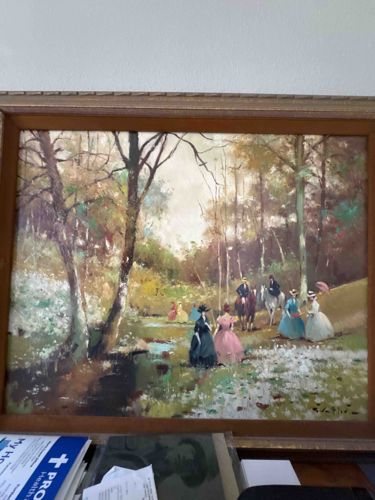
Mid-20th Century Impressionist-Style Pastoral Landscape Painting

Fine Art - Paintings

AI Estimated Value

·Not an official valuation·Verify before acting

$400 - $700

As of June 23, 2026

AI Item Analysis

·AI can make mistakes·Verify before acting
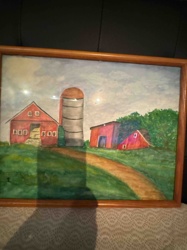
This is a rectangular oil or acrylic painting on canvas, housed in a traditional tiered wooden frame with a gilded or light-colored finish and a raised cove. The artwork depicts a bucolic park or woodland scene in a late-19th-century or Belle Époque style, featuring several figures in Victorian-era attire. The composition includes tall, slender trees with dappled foliage, a small stream or path in the foreground, and a group of figures consisting of women in voluminous dresses of blue, pink, and white, alongside two equestrians on horseback. The color palette is dominated by earthy greens, browns, and ochre, contrasted with the vibrant hues of the figures' clothing and a soft, luminous sky. The technique is impressionistic, utilizing visible, loose brushstrokes to suggest light and movement rather than precise detail. A signature is visible in the lower right corner, though currently illegible without higher resolution. The condition appears fair, with visible aged patina on the frame and potential light surface grime on the canvas. The style suggests it is a mid-20th-century decorative piece (circa 1950s-1970s) influenced by European romanticism and the French Impressionist movement, designed for residential display.


AI Appraisal Report

·AI can make mistakes·Verify before acting
Upon direct visual examination of this oil on canvas, I have identified it as a mid-20th-century decorative pastoral landscape executed in the French Impressionist revival style. The composition, featuring figures in Belle Époque attire and equestrians, is characteristic of commercial ‘gallery art’ produced between 1950 and 1975 for the burgeoning middle-class residential market. The brushwork is gestural and atmospheric, prioritizing decorative appeal over technical precision or historical innovation. The frame is a period-correct tiered wooden moulding with a gilded wash, showing typical age-related wear and minor abrasions consistent with its era. From a market perspective, works of this nature are valued based on their aesthetic utility and size rather than their provenance or the identity of the artist, as the signature likely belongs to a prolific commercial studio painter. Demand for traditional pastoral scenes remains steady in the secondary decorative market but lacks the rarity or 'blue-chip' investment potential of genuine 19th-century works. The valuation is influenced by the fair condition of the canvas; however, apparent surface grime and yellowing varnish suggest a need for professional cleaning to restore the original vibrancy of the palette. IMPORTANT LIMITATIONS: This appraisal is based solely on digital images. A definitive valuation is subject to a physical inspection to confirm the medium (ensuring it is not a canvas transfer/print), examine the stretcher bars for historical dating, and utilize UV light to detect overpainting or repairs. To fully authenticate the signature, research into specific regional artist registries or provenance documentation from the original point of sale would be required. Scientific testing such as pigment analysis would be necessary to rule out modern synthetic binders if a pre-1940s origin were claimed.

Get your items appraised

Instant estimates of your treasures with AI-powered appraisals

Browse More Appraisals