These notes were written by the person who submitted this item. Appraiser.AI has not verified them, and the AI's identification and estimate may rely on them.
AI Estimated Value
Not an official valuation
$250-400
AI estimate as of September 6, 2025 · verify with a professional before acting
AI-Generated · Verify before acting
Everything on this page is generated by AI for informational purposes only. AI can make mistakes — the AI may misidentify items or misattribute them (artist, maker, brand, designer, origin, era). This is not an official valuation and should not be used for insurance, sale, tax, estate, legal, or lending purposes — or any decision requiring a certified appraisal. It is not an authoritative claim about any person, brand, or rights holder — do not share or rely on it as a factual statement about a third party. Always consult qualified professionals before making financial decisions.
This analysis also relies on unverified notes provided by the user, which may be incomplete or inaccurate and could affect the result.
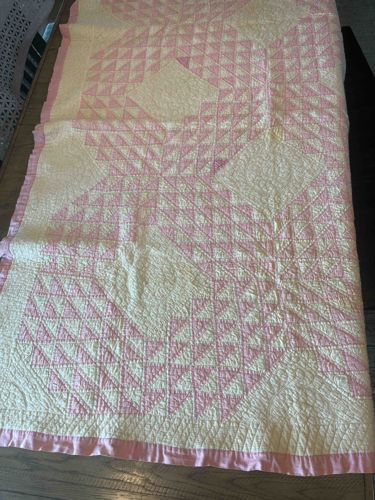
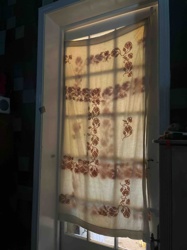
This is a vintage cotton quilt, measuring approximately 65 inches by 74 inches, constructed in a classic 'Flying Geese' geometric pattern. The quilt primarily features two colors: a soft, light pink and a muted cream or off-white. The 'Flying Geese' blocks are arranged to create larger square and rectangular design elements across the quilt's surface, with the pink triangles forming the 'geese' against the cream background, and vice-versa, creating a dynamic visual effect. The quilting stitches are clearly visible, indicating traditional hand-quilting or a high-quality machine quilting, showcasing a diamond grid pattern within the cream areas and outlining the geometric shapes. The overall impression suggests good craftsmanship, with neatly pieced blocks and consistent stitching. The edges of the quilt are finished with a plain pink binding that matches the pink fabric used in the main design, providing a neat and durable border. In terms of condition, the quilt appears to be in good vintage condition, exhibiting some signs of age such as slight creasing or compression of the batting, which is typical for a well-used or stored textile of its age. There are no immediately apparent rips, tears, or major stains, although a small, subtle discolored spot is discernible in one of the cream sections near the center, suggesting minor wear or a historical stain. The colors appear to be well-preserved, with no significant fading visible. Based on its design, stitching style, and general appearance, it likely dates from the mid-20th century, possibly 1950s or 1960s, though earlier or later dates are possible. The soft color palette and classic pattern give it a timeless and appealing aesthetic.
AI Appraisal Report
Based on my visual examination of the provided image and description, this vintage Pink and Cream 'Flying Geese' Pattern Quilt presents as a charming example of mid-20th century textile craftsmanship. The stated dimensions of 65 x 74 inches are a good usable size. The 'Flying Geese' pattern is a classic and highly desirable design, and the soft pink and cream color palette is appealing and well-preserved, showing no significant fading. The craftsmanship appears good, with neat piecing and consistent quilting stitches, whether hand or high-quality machine. This indicates a well-made piece.
In terms of condition, it appears to be in good vintage shape, consistent with its age. I note the typical slight creasing/compression of the batting. The description mentions a small, subtle discolored spot in a cream section near the center. While minor, any visible staining or imperfection can slightly impact value. Overall, the condition is strong for its age.
Market conditions for vintage quilts are generally steady, with strong demand for well-preserved, classic patterns in desirable colorways. Comparables would include other mid-century cotton quilts of similar size and pattern. While not exceptionally rare, a well-executed 'Flying Geese' quilt commands good interest.
My assessment of authenticity is based solely on the visual information provided. The materials (cotton), construction style (piecing, apparent quilting method), and design are consistent with a mid-20th century origin as described. Limitations in authenticating from images alone include the inability to physically inspect stitch quality (hand vs. machine close-up), assess fiber content definitively, or confirm the age of the fabrics. A full authentication would require in-person examination to verify thread tension, fiber type, and construction techniques. Provenance documentation (e.g., family history or acquisition records) would also enhance authenticity and value. Scientific testing of dyes or fibers would be needed for absolute dating, but is generally not undertaken for items in this price range.