These notes were written by the person who submitted this item. Appraiser.AI has not verified them, and the AI's identification and estimate may rely on them.
AI Estimated Value
Not an official valuation
$600 - $900
AI estimate as of October 16, 2025 · verify with a professional before acting
AI-Generated · Verify before acting
Everything on this page is generated by AI for informational purposes only. AI can make mistakes — the AI may misidentify items or misattribute them (artist, maker, brand, designer, origin, era). This is not an official valuation and should not be used for insurance, sale, tax, estate, legal, or lending purposes — or any decision requiring a certified appraisal. It is not an authoritative claim about any person, brand, or rights holder — do not share or rely on it as a factual statement about a third party. Always consult qualified professionals before making financial decisions.
This analysis also relies on unverified notes provided by the user, which may be incomplete or inaccurate and could affect the result.
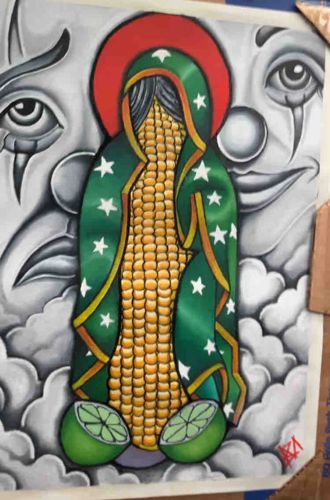
This artwork depicts a unique interpretation of Our Lady of Guadalupe, rendered in a style often associated with Chicano or lowrider art, and possibly prison art given the context. The central figure, reminiscent of the Virgin Mary, is presented with a red halo and a green robe adorned with white stars, bordered with gold. Instead of a traditional human form, her body is composed entirely of a vibrant yellow ear of corn, symbolizing abundance and indigenous connection. Below her, two brightly colored green lime halves are carefully placed, further emphasizing a connection to natural elements and perhaps cultural significance within Mexican cuisine or tradition. The background features a large, stylized clown face, depicted with heavy grayscale shading, showcasing tear-like lines on its eyes and a pensive or melancholic expression. The clown's eyes are prominent, one almost directly behind the Virgin figure's head, giving a slightly unsettling yet intriguing juxtaposition. The figure and elements are surrounded by soft, grey and white clouds, lending depth and a dreamlike quality to the composition. The colors are rich and saturated, with strong contrasts between the greens, reds, and yellows, set against the muted grays of the clown and clouds. The medium appears to be a mixed media, possibly airbrush or acrylic on paper or board, evident from the smooth gradients and sharp lines. There's a visible signature or stylized mark in red in the bottom right corner, suggesting an artist's personal touch. The overall condition appears good, with no visible damage or significant wear, though the edges of the substrate show some minor handling or framing marks from the context image. The artwork exhibits a distinct blend of religious iconography, cultural symbolism, and street art aesthetics, showcasing a high degree of detail and control in its execution, particularly in the shading and color blending.
AI Appraisal Report
I have carefully examined the provided image of the 'Our Lady of Guadalupe Corn and Lime Cholo Clown Art.' Based on this visual inspection, the artwork appears to be in good condition, showing no significant damage or wear to the primary image. Minor handling or framing marks are perceptible at the substrate's edges, which is common. Authenticity, based solely on the image, seems high for its aesthetic. The unique stylistic blend of religious iconography, Chicano/lowrider aesthetics, and potential prison art motifs is consistent with contemporary cultural expressions.
Market conditions for Chicano and prison art have seen increasing interest, particularly for pieces that display strong artistic merit and unique thematic interpretations. This piece's vibrant colors, intricate shading, and compelling juxtaposition of sacred and street art elements make it a strong example. Comparables from known Chicano and prison artists with similar detail and thematic depth can fetch several hundred to over a thousand dollars, depending on the artist's recognition and provenance. The demand for such culturally significant and visually striking works is steady, and its unique composition contributes to its rarity.
Factors significantly impacting value include its strong visual narrative, the presumed originality of the design, and the skillful execution of the medium. However, my assessment is limited by the lack of physical examination. For full authentication and a more precise valuation, an in-person examination would be crucial to assess the actual medium, dimensions, and substrate. Provenance documentation, such as details about the artist, the context of its creation (especially if genuinely prison art), and its exhibition history, would substantially increase its value and authenticity. Scientific testing, like pigment analysis, could confirm the age and materials used if dating becomes a concern. The signature in the bottom right corner should be further investigated to identify the artist and provide a robust verifiable provenance.