AI Appraisal Estimate

AI-generated estimates · not official valuations

From the user

What was submitted

Photo and notes provided by the user — not generated by AI

Submitted item photo
Submitted photo · May 17, 2026

User's notes

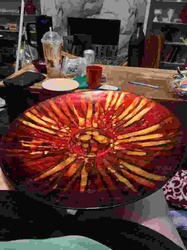
Blown glass with aventurine

AI analysis below

AI appraisal

AI analysis & estimate

AI-Generated · Verify before acting

Everything below is generated by AI for informational purposes only. AI can make mistakes — the AI may misidentify items or misattribute them (artist, maker, brand, designer, origin, era). This is not an official valuation and should not be used for insurance, sale, tax, estate, legal, or lending purposes — or any decision requiring a certified appraisal. It is not an authoritative claim about any person, brand, or rights holder — do not share or rely on it as a factual statement about a third party. Always consult qualified professionals before making financial decisions.

Note

This analysis also relies on unverified notes provided by the user, which may be incomplete or inaccurate and could affect the result.

Read the full disclaimer

AI Identification

·Not independently authenticated·Verify before acting

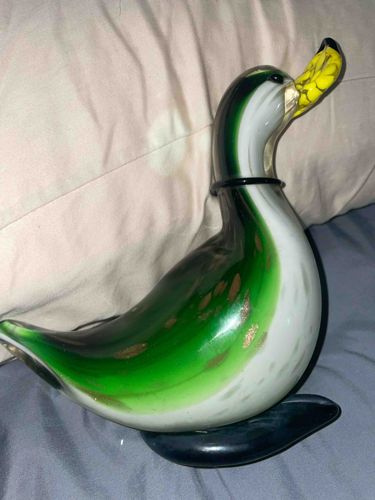
Murano Style Hand-Blown Glass Duck with Aventurine Inclusions

Art Glass / Decorative Collectibles

AI Estimated Value

·Not an official valuation·Verify before acting

$175 - $250

As of May 17, 2026

AI Item Analysis

·AI can make mistakes·Verify before acting
This is a hand-blown glass duck figurine, characterized by its vibrant color palette and technical glass-working techniques. The piece features a striking combination of emerald green glass layered over a white opaque interior, creating a deep, luminous effect throughout the body. A defining feature is the inclusion of 'aventurine'—tiny, suspended flecks of metallic copper that glitter within the green glass, particularly concentrated along the back and neck. This technique is a hallmark of high-quality Venetian glassmaking. The duck is modeled with a long, arched neck, an applied black glass ring or collar, and a yellow, textured bill. The base consists of a solid, dark-toned glass foot for stability. Its construction demonstrates characteristic Murano-style techniques from the mid-20th century, likely dating between the 1950s and 1970s. The smooth, polished exterior shows fine craftsmanship, with no visible cracks or large chips in the provided view, though standard shelf wear on the bottom would be expected for a vintage piece. The stylized form and rich colors suggest it may be from a workshop such as Seguso or Archimede Seguso, though no maker's mark is visible in the photo.
AI Appraisal Report

·AI can make mistakes·Verify before acting
Upon visual examination of this avian figurine, I find it to be a compelling example of Mid-Century Modern Venetian glassmaking. The execution of the 'Aventurine' technique—the suspension of copper crystals within the emerald green sommerso layer—is consistent with the high-caliber production seen in Murano workshops between 1950 and 1970. The stylized form, characterized by the elongated neck and applied yellow bill, mirrors the aesthetic popularized by Archimede Seguso and ALFA (Arturo Lavorazione Fine Artistica). The condition appears excellent from the provided view, with the glass retaining a high luster and showing no internal fractures or 'glass sickness.' Market demand for Murano animals remains stable, particularly for pieces utilizing the aventurine technique, which collectors prize for its decorative brilliance. While larger or signed pieces can reach the $400+ range, this unsigned medium-sized work sits comfortably in the $175-$250 bracket based on recent auction realizations for similar 'Aventurine' ducks. A significant limitation of this appraisal is the absence of a maker’s mark or original foil label. Attribution to a specific furnace like Seguso is currently based on stylistic affinity rather than definitive proof. To achieve a higher valuation or confirm authenticity, an in-person inspection of the base for specific pontil scar characteristics and 'shelf wear' patterns is required. Provenance documentation, such as an original sales receipt or inclusion in a known catalog raisonné, would further solidify its standing. Without physical handling to assess weight and density, I cannot definitively rule out high-quality contemporary imitations from other regions.

Get your items appraised

Instant estimates of your treasures with AI-powered appraisals

Browse More Appraisals