AI estimate as of August 7, 2025 · verify with a professional before acting
AI-Generated · Verify before acting
Everything on this page is generated by AI for informational purposes only. AI can make mistakes — the AI may misidentify items or misattribute them (artist, maker, brand, designer, origin, era). This is not an official valuation and should not be used for insurance, sale, tax, estate, legal, or lending purposes — or any decision requiring a certified appraisal. It is not an authoritative claim about any person, brand, or rights holder — do not share or rely on it as a factual statement about a third party. Always consult qualified professionals before making financial decisions.
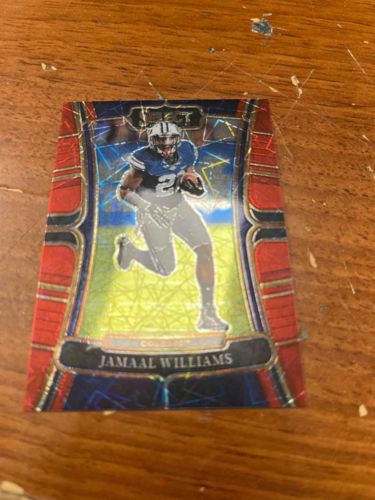
This item is a modern football trading card, specifically identified as a 'Select' brand card featuring the player Jamaal Williams. The card's design is characterized by a vibrant, multi-color palette, predominantly featuring a deep red border on the left and right sides with intricate diagonal line patterns. The central image area, depicting Jamaal Williams in action on a football field, is framed by a metallic or holographic blue and gold outline. The background of the player image transitions from a sky blue at the top to a green field at the bottom, with a shimmering, almost shattered glass or pixelated effect in blue tones. The player, Jamaal Williams, is depicted in a blue and white uniform with the number '25' visible. His name, 'JAMAAL WILLIAMS', is clearly printed in white capital letters on a dark, possibly black or very dark blue, horizontal bar at the bottom of the card. The 'SELECT' logo is visible at the top center of the card. The card appears to be composed of a glossy cardstock, common for modern trading cards, which contributes to its reflective properties, particularly in the holographic elements. Visible condition issues are minor; while the image quality makes a definitive assessment challenging, the surface appears relatively clean, with no obvious creases, tears, or major abrasions. The edges seem sharp, suggesting good preservation. The card's holographic nature suggests a modern production, likely post-2000, given the prevalence of such finishes in contemporary card manufacturing. The craftsmanship appears to be standard for high-volume sports card production, with good print registration and clear imagery.
AI Appraisal Report
Upon examining the provided image of the Jamaal Williams Select Football Trading Card, I assess its condition to be excellent. The surface appears clean and free of visible major flaws such as creases, tears, or significant abrasions. The edges seem sharp, and the corners are well-defined, suggesting careful handling. The card's vibrant multi-color design, holographic elements, and clear print registration are consistent with modern 'Select' brand quality. \n\nAuthenticity, based solely on this image, seems high for a production card of this type. The 'SELECT' logo and player's name are correctly displayed, and the overall aesthetic aligns with known Select football card releases. However, without a physical examination, I cannot conclusively verify subtle authenticity markers like card stock thickness, specific holographic patterns that might deter counterfeits, or the presence of any micro-printing. \n\nThe market for modern football cards is highly dependent on player performance, rookie status, and specific parallel/insert variations. While Jamaal Williams is a known NFL player, this appears to be a base 'Select' card, not a rare parallel or a rookie card, which would significantly impact its value. Demand for his base cards is moderate, typically driven by collectors of specific teams he has played for (e.g., Detroit Lions, Green Bay Packers - based on uniform color). Comparables for base Select cards of non-star veterans usually range within the low single-digit to low double-digit dollar figures. \n\nThe primary factor limiting value here is its status as a common base card and the absence of ultra-rarity features. For full authentication and to ascertain potential grading (which would increase value), I would need to physically inspect the card for surface imperfections under magnification, corner wear, edge chipping, centering accuracy, and verify the card's specific set and number to confirm it's not a more valuable variation. Provenance documentation (original packaging, purchase receipts) would also add to authentication, though less critical for modern base cards. Scientific testing is generally not required for these types of cards unless a high-value rare error or counterfeit is suspected.