These notes were written by the person who submitted this item. Appraiser.AI has not verified them, and the AI's identification and estimate may rely on them.
AI Estimated Value
Not an official valuation
$40-75
AI estimate as of June 21, 2025 · verify with a professional before acting
AI-Generated · Verify before acting
Everything on this page is generated by AI for informational purposes only. AI can make mistakes — the AI may misidentify items or misattribute them (artist, maker, brand, designer, origin, era). This is not an official valuation and should not be used for insurance, sale, tax, estate, legal, or lending purposes — or any decision requiring a certified appraisal. It is not an authoritative claim about any person, brand, or rights holder — do not share or rely on it as a factual statement about a third party. Always consult qualified professionals before making financial decisions.
This analysis also relies on unverified notes provided by the user, which may be incomplete or inaccurate and could affect the result.
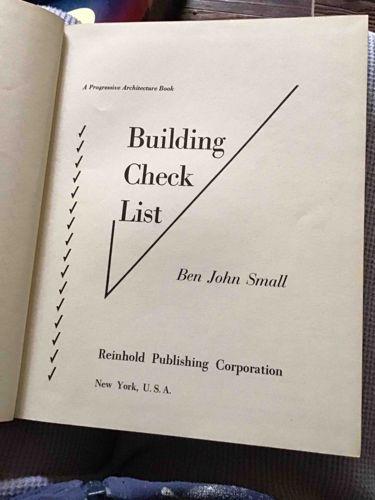
The item is an open book, revealing its title page. The page is an off-white or cream color, suggesting aged paper but appears clean with no significant discoloration. The text is printed in black ink. The title, "Building Check List," is prominently displayed in a bold serif font, stacked vertically, with "Building" at the top, "Check" in the middle, and "List" at the bottom. Above the main title, 'A Progressive Architecture Book' is printed in a smaller, lighter font, indicating the genre or publisher's series. Below the title, the author's name, 'Ben John Small', is centered in a slightly smaller, perhaps italicized, serif typeface. At the bottom of the page, the publisher, 'Reinhold Publishing Corporation,' and its location, 'New York, U.S.A.', are listed. A distinctive graphic design element on the left side of the page is a vertical column of twelve checkmark symbols, suggesting the theme of a checklist. An abstract, bold black diagonal line extends from the top right corner of the page, passes through a large inverted checkmark symbol positioned near the center-left, and then continues downwards, creating a dynamic visual element. The visible condition is good, with no apparent tears, creases, or major stains. The pages appear tightly bound, indicating good construction. The aesthetic suggests a mid-20th-century publication, likely from the architecture or building industry, characterized by a clean, functional design with a touch of modernist graphic sensibility.
AI Appraisal Report
I have examined the provided image of "Building Check List" by Ben John Small, noting its condition and design elements. Based on the visual evidence, the book appears to be in good condition, as stated by the owner. The pages show no apparent tears, creases, or significant discoloration, and the binding appears tight. This aligns with the owner's description of "Good condition." The aesthetic strongly suggests a mid-20th-century publication, likely from the 1950s or 1960s, given the clean, functional design with modernist graphic sensibilities typical of architectural publications of that era. Authenticity, based solely on this image, seems high for a mass-produced book. There are no obvious signs of counterfeiting or alteration. However, a full authentication would require in-person examination to verify paper quality, printing techniques, and any hidden defects not visible in the photograph. Provenance documentation, such as original purchase receipts or previous ownership records, would further solidify authenticity and historical value. For a book of this nature and vintage, market demand is niche, primarily appealing to collectors of architectural history, mid-century graphic design, or professionals in the building industry interested in historical reference materials. Such specialized interest typically translates to a steady but not exceptionally high demand. Rarity for this specific title might be moderate; while not a blockbuster, it's also not a common mass-market paperback. Comparables would ideally be other Ben John Small titles or similar architectural checklists from the same period in comparable condition. Factors impacting value significantly include the excellent condition, the distinctive modernist graphic design, and its relevance to architectural history. Without physical inspection, I cannot confirm the presence of any inscriptions, foxing, or spine wear that might not be evident in the image.