These notes were written by the person who submitted this item. Appraiser.AI has not verified them, and the AI's identification and estimate may rely on them.
AI Estimated Value
Not an official valuation
$450-700
AI estimate as of August 29, 2025 · verify with a professional before acting
AI-Generated · Verify before acting
Everything on this page is generated by AI for informational purposes only. AI can make mistakes — the AI may misidentify items or misattribute them (artist, maker, brand, designer, origin, era). This is not an official valuation and should not be used for insurance, sale, tax, estate, legal, or lending purposes — or any decision requiring a certified appraisal. It is not an authoritative claim about any person, brand, or rights holder — do not share or rely on it as a factual statement about a third party. Always consult qualified professionals before making financial decisions.
This analysis also relies on unverified notes provided by the user, which may be incomplete or inaccurate and could affect the result.
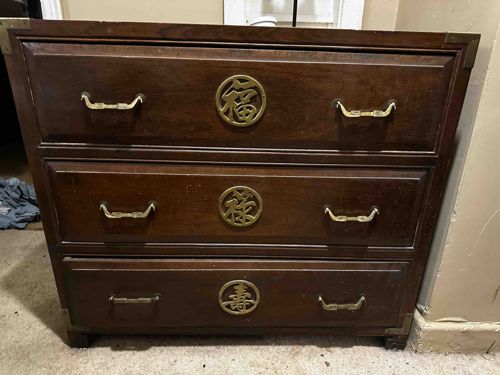
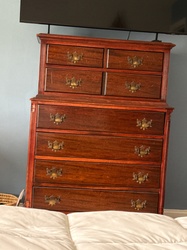
This is a vintage Chinese-style wooden chest of drawers, likely dating from the 1960s given the provided context of Taipei, Taiwan. The piece features three drawers, each adorned with a pair of brass pull handles and a central circular brass medallion. The wood appears to be a dark-stained hardwood, possibly rosewood or a similar dense timber, exhibiting a rich, deep brown hue with visible grain patterns. The construction suggests a substantial and sturdy build, typical of furniture from that era. Notable features include the intricate brass medallions, which depict Chinese characters. From top to bottom, these characters appear to be 'Fu' (福 - blessing/good fortune), 'Lu' (祿 - prosperity/emolument), and 'Shou' (壽 - longevity), collectively forming the 'Fu Lu Shou' motif, which is a common and auspicious decorative theme in Chinese culture. The brass hardware shows a natural patina consistent with age, indicating some wear and oxidation, but no significant damage. The wood surface has some visible scratching, scuffs, and areas of wear, particularly on the top surface and drawer fronts, which is expected for an item of its age and use. The corners of the chest, particularly on the top, are reinforced with brass brackets, adding both structural integrity and decorative appeal. The overall craftsmanship suggests a well-made piece, likely hand-finished, with joinery that appears robust. The design is traditional Chinese, emphasizing rectangular forms and functional elegance, indicative of a mid-20th-century Asian furniture aesthetic.
AI Appraisal Report
Based on my visual examination of the provided image, this Chinese-style hardwood chest of drawers appears to be a genuine vintage piece, consistent with its stated origin of Taipei, Taiwan, and a 1960s timeframe. The "Fu Lu Shou" brass medallions are characteristic of auspicious Chinese decorative motifs, and their presence, along with the overall design, supports the authenticity as a mid-20th-century Chinese furniture item rather than a modern reproduction. The dark-stained hardwood, likely rosewood given the era and region, exhibits natural wear, including scuffs and scratches on the top and drawer fronts, which is entirely consistent with an item of this age and practical use. The brass hardware shows an appropriate patina, further validating its age.
In terms of market conditions, vintage Asian hardwood furniture from the mid-20th century typically sees consistent demand, particularly pieces with cultural motifs like the "Fu Lu Shou." Comparables in similar condition and quality often fetch prices reflecting their craftsmanship and historical design. While not exceedingly rare, well-preserved pieces featuring traditional iconography are sought after by collectors and interior designers. The primary factor impacting its value is its good overall condition despite the surface wear.
However, it is crucial to state the limitations of an appraisal based solely on images. While the visual indicators are strong, I cannot definitively confirm the precise wood species without in-person inspection, nor can I verify the structural integrity (e.g., soundness of joinery) or the absence of hidden repairs or damage. Full authentication would require a hands-on physical examination to assess the wood grain, construction techniques, and feel the weight and solidity. Provenance documentation, such as original purchase receipts or family records, would further solidify its history and authenticity. Scientific testing, like wood identification analysis, could confirm the species positively.