These notes were written by the person who submitted this item. Appraiser.AI has not verified them, and the AI's identification and estimate may rely on them.
AI Estimated Value
Not an official valuation
$40-70
AI estimate as of August 23, 2025 · verify with a professional before acting
AI-Generated · Verify before acting
Everything on this page is generated by AI for informational purposes only. AI can make mistakes — the AI may misidentify items or misattribute them (artist, maker, brand, designer, origin, era). This is not an official valuation and should not be used for insurance, sale, tax, estate, legal, or lending purposes — or any decision requiring a certified appraisal. It is not an authoritative claim about any person, brand, or rights holder — do not share or rely on it as a factual statement about a third party. Always consult qualified professionals before making financial decisions.
This analysis also relies on unverified notes provided by the user, which may be incomplete or inaccurate and could affect the result.
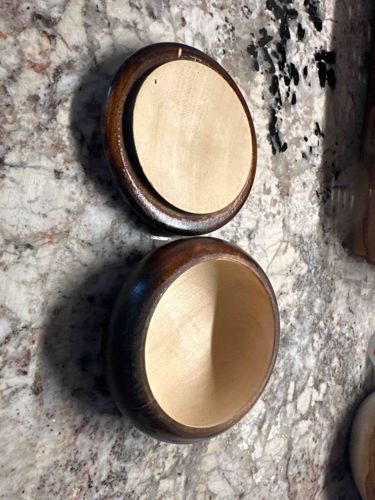
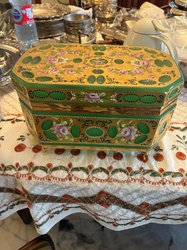
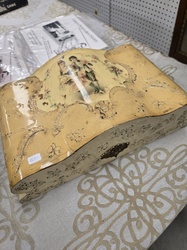
This is a small, turned wooden box with a removable lid, designed for storage or as a decorative item. It measures approximately 2.5 inches in height and 5.5 inches in width, indicating a relatively compact, rounded form. The exterior of the box and the top surface of the lid are finished in a rich, dark brown stain or varnish, suggesting a warm wood like walnut, mahogany, or a similarly dark-toned hardwood. This dark finish exhibits a smooth, glossy sheen, indicating a well-polished surface. However, some minor wear or very slight scuffing might be present, consistent with a used or vintage item, though the overall condition appears good from the provided image. In contrast to the dark exterior, the interior of the box and the underside of the lid feature the natural, lighter tone of the wood, likely a pale, fine-grained wood such as maple or birch, left unfinished or with a clear, matte sealant. This creates a pleasing visual contrast between the dark exterior and light interior. The construction appears to be turned wood, given the smooth, rounded contours and uniform grain visible on both parts. The lid fits snugly into a recess on the box opening, designed for a secure closure. No obvious maker's marks, signatures, or intricate carvings are discernible from the images, suggesting either a studio piece, a handcrafted item, or a mass-produced item without prominent branding. This simple, elegant design is characteristic of many mid-20th century to contemporary wooden articles, emphasizing functionality and the natural beauty of the wood, making it suitable for a variety of uses from trinket storage to a desk accent. The craftsmanship appears to be of good quality, with smooth transitions and a consistent finish.
AI Appraisal Report
Upon examining the provided image and specifications for this Turned Wooden Box with Removable Lid, I can offer the following appraisal. The box, measuring 2.5 inches in height and 5.5 inches in width, exhibits a pleasing aesthetic with its dark exterior stain and contrasting lighter interior, indicative of two different wood types or finishes. The smooth, glossy sheen on the exterior suggests a well-executed finish, likely a varnish or lacquer, over a hardwood like walnut or mahogany. The condition appears good, with minor wear or slight scuffing noted, consistent with age or gentle use, which does not significantly detract from its appeal. The craftsmanship appears competent, with uniform turning and a snug-fitting lid.
From a market perspective, comparable turned wooden boxes, especially those without definitive maker's marks or significant artistic embellishment, generally fall into the decorative arts category rather than collectible fine art. Demand for such items is steady for functional or accent pieces. Rarity is not a significant factor here; similar turned wooden items are relatively common. Value is primarily driven by aesthetic appeal, condition, size, and material quality. The absence of discernible maker's marks, signatures, or unique historical provenance limits its value to that of a decorative accessory rather than a highly collectible antique.
The primary limitation of this appraisal is the lack of physical examination. While the image provides a good indication of condition and style, an in-person inspection would allow for a definitive assessment of the wood type(s), the exact nature and extent of any wear or scuffing, the precise fit of the lid, and the quality of the finish and turning beyond what is photographically discernible. Without direct inspection, authentication of an artist or period is impossible, and even identifying the specific wood species remains speculative. Provenance documentation, if available, would further enhance authentication and potentially value, but its absence is common for such utilitarian decorative items.