AI estimate as of November 8, 2025 · verify with a professional before acting
AI-Generated · Verify before acting
Everything on this page is generated by AI for informational purposes only. AI can make mistakes — the AI may misidentify items or misattribute them (artist, maker, brand, designer, origin, era). This is not an official valuation and should not be used for insurance, sale, tax, estate, legal, or lending purposes — or any decision requiring a certified appraisal. It is not an authoritative claim about any person, brand, or rights holder — do not share or rely on it as a factual statement about a third party. Always consult qualified professionals before making financial decisions.
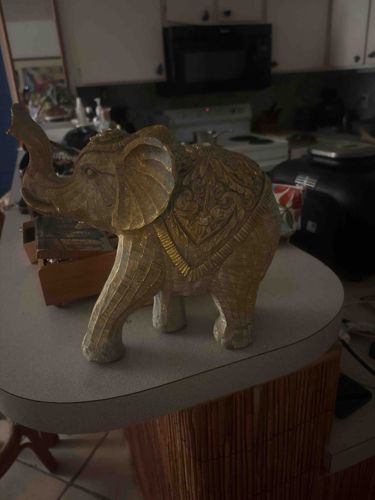
This item is a decorative figurine depicting an elephant, likely carved from a lightweight material such as wood or resin, and finished with a gilded, antiqued effect. The primary color is a distressed gold or brass hue, with darker accents in the recesses suggesting age or a deliberate antiquing process. The elephant is depicted with its trunk raised upwards, a posture often associated with good luck or prosperity in various cultures. Its ears are prominently fanned out, and its legs are thick and sturdy, supporting its body.
One of the most striking features is the intricate carving or molding on the elephant's body. There are detailed patterns on its head, back, and sides, mimicking ceremonial adornments. These patterns appear to be floral or scrollwork motifs, typical of Asian art styles. A saddle-like blanket or covering is clearly delineated on its back, also adorned with complex designs. The craftsmanship suggests either hand-carving or a very detailed mold. The surface shows some wear, particularly on the raised edges and feet, where the base material or a lighter undercoat is visible, contributing to its aged aesthetic. The overall condition appears good for a decorative item, with no obvious major breaks or repairs, though some minor scuffs or loss of gilding may be present upon closer inspection. The style is indicative of items produced for home decoration, often inspired by traditional Asian or Indian artistry, possibly dating from the late 20th century to early 21st century. It possesses a certain gravitas and exotic appeal, making it a focal point in a room.
AI Appraisal Report
Based on my visual examination of the provided image, this carved and gilt elephant figurine presents as a decorative item, likely crafted from a lightweight material such as resin or wood, finished with a distressed gold or brass-toned gilding. Its raised trunk, intricate floral/scrollwork patterns, and saddle-like adornments are consistent with a decorative piece inspired by traditional Asian or Indian artistry, often associated with good fortune. The overall condition appears good for a decorative item of its type, showing intentional antiquing and some minor wear consistent with display, such as slight loss of gilding on high points, which contributes to its aged aesthetic rather than detracting significantly from its decorative appeal.
From the image alone, authenticity as a truly antique or high-craft collectible cannot be confirmed. The style is common in late 20th to early 21st-century mass-produced home decor. My assessment of value is based on its aesthetic appeal, decorative function, and market for similar contemporary decorative items. These types of figurines are widely available, leading to moderate demand in the secondary market. Rarity is low. Factors impacting value include the material's perceived quality, the intricacy of detail, and overall condition. Without physical inspection, I cannot confirm the exact material (e.g., solid wood vs. resin), the method of decoration (hand-carved vs. molded), or provenance.
For full authentication regarding its age, material, and origin, an in-person examination would be crucial to assess the true craftsmanship, weight, and material composition. Provenance documentation, if available, would significantly aid in determining its history and potential value as an antique or artist-made piece. Scientific testing of materials and finishes could also provide definitive answers regarding its age and composition. Based on the visual evidence, I assess its value as a decorative object in the secondary market.