These notes were written by the person who submitted this item. Appraiser.AI has not verified them, and the AI's identification and estimate may rely on them.
AI Estimated Value
Not an official valuation
$3-7
AI estimate as of July 28, 2025 · verify with a professional before acting
AI-Generated · Verify before acting
Everything on this page is generated by AI for informational purposes only. AI can make mistakes — the AI may misidentify items or misattribute them (artist, maker, brand, designer, origin, era). This is not an official valuation and should not be used for insurance, sale, tax, estate, legal, or lending purposes — or any decision requiring a certified appraisal. It is not an authoritative claim about any person, brand, or rights holder — do not share or rely on it as a factual statement about a third party. Always consult qualified professionals before making financial decisions.
This analysis also relies on unverified notes provided by the user, which may be incomplete or inaccurate and could affect the result.
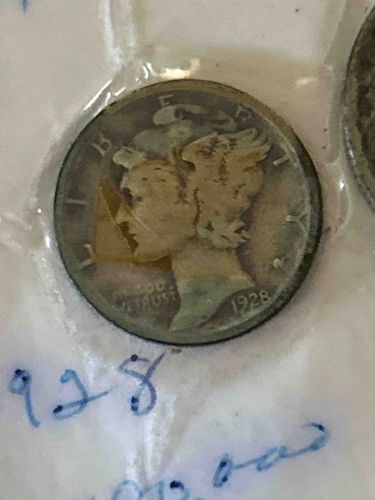
The item is a 1928 United States Mercury Dime, also known as the Winged Liberty Head dime. This coin features a profile portrait of Lady Liberty wearing a winged Phrygian cap on its obverse, which was often mistaken for the Roman god Mercury, hence its popular name. The visible obverse design shows reasonable detail in Liberty's face and wing, though some wear is evident on the higher points of the relief. The legend "LIBERTY" is partially visible along the top rim. Below Liberty's chin, the motto "IN GOD WE TRUST" is discernible. The date "1928" is clearly legible at the bottom right of the obverse. The coin appears to be made of silver, consistent with Mercury Dimes from this period (90% silver, 10% copper).
Physical characteristics show a circular metal coin, typical in size for a dime (approx. 17.9 mm diameter, 1.35 mm thickness). The surface exhibits significant toning, with areas of golden-brown and iridescent hues, likely due to prolonged exposure to air or environmental factors while being stored. There are noticeable dark spots and possibly some signs of environmental damage or residue, particularly to the left of Liberty's forehead and around the rim. The details are softened, suggesting circulation wear, but the major elements are still well-defined. The specific mint mark, if present, is not visible in the provided image. The coin is encased in what appears to be a clear plastic or cellophane holder, consistent with how coins are often stored by collectors. This holder itself shows some creases and has blue ink writing ('928' and other illegible numbers) on its surface, not on the coin itself. The overall condition suggests a circulated coin with notable toning and some surface imperfections.
AI Appraisal Report
I have examined the provided image and description of the 1928 United States Mercury Dime. Based on visual assessment, the coin appears authentic, consistent with known characteristics of this issue. The "1928" date is clearly legible, and the visible design elements align with genuine Mercury Dimes.
Regarding condition, this coin is clearly circulated. The softening of details on Liberty's face and wing, along with the partially visible "LIBERTY" legend, indicate significant wear, placing it in the Fine (F) to Very Fine (VF) range, rather than an uncirculated or extremely fine grade. The toning, while present, is fairly common for silver coins of this age and can sometimes be desirable to collectors if attractive; however, the dark spots and potential environmental residue are less appealing and suggest mishandling or poor storage, negatively impacting its eye appeal.
Market conditions for common date circulated Mercury Dimes are relatively stable. While popular, 1928 is not a key date. Its value is primarily driven by its silver content ("junk silver") and a modest numismatic premium. Comparables in similar circulated condition typically fetch values slightly above their melt value. Demand for common circulated Mercury Dimes is moderate, primarily from new collectors, silver stackers, or those filling out sets.
The primary factors impacting this coin's value are its circulated condition, the presence of toning and surface imperfections outweighing any patina benefit, and its common date. The most significant limitation of this appraisal is the absence of a visible mint mark. Without this, I cannot fully determine its specific mintage figures or rarity relative to D, S, or P mint marks. Furthermore, I can only assess authenticity based on visual cues; a physical examination would be necessary to confirm metallic composition, detect any alterations, and definitively rule out counterfeits. Provenance documentation, though not typically extensive for common circulated coins, would offer additional verification. Scientific testing (e.g., specific gravity, XRF) would confirm its silver content more precisely if authenticity were in question.
Given these factors, this coin presents as a common circulated example with moderate wear and some surface issues.