AI Appraisal Estimate

AI-generated estimates · not official valuations

From the user

What was submitted

Photo and notes provided by the user — not generated by AI

Submitted item photo
Submitted photo · June 14, 2026

User's notes

No additional notes provided.

AI analysis below

AI appraisal

AI analysis & estimate

AI-Generated · Verify before acting

Everything below is generated by AI for informational purposes only. AI can make mistakes — the AI may misidentify items or misattribute them (artist, maker, brand, designer, origin, era). This is not an official valuation and should not be used for insurance, sale, tax, estate, legal, or lending purposes — or any decision requiring a certified appraisal. It is not an authoritative claim about any person, brand, or rights holder — do not share or rely on it as a factual statement about a third party. Always consult qualified professionals before making financial decisions.

Read the full disclaimer

AI Identification

·Not independently authenticated·Verify before acting

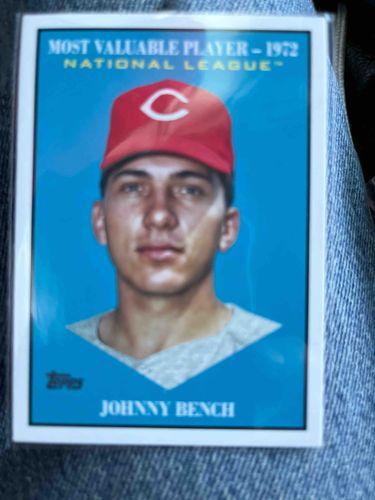
Johnny Bench 1972 Most Valuable Player National League Baseball Card

Sports Memorabilia

AI Estimated Value

·Not an official valuation·Verify before acting

$30 - $70

As of June 14, 2026

AI Item Analysis

·AI can make mistakes·Verify before acting
This item is a collectible baseball card, specifically featuring Johnny Bench, identified as the 'Most Valuable Player - 1972 National League'. The card presents a portrait-style photograph of Johnny Bench, who is depicted wearing a red baseball cap with a white 'C' logo, indicating his affiliation with the Cincinnati Reds. His attire appears to be a grey or light-colored baseball jersey, visible at the neckline and shoulders. The background of the portrait is a vibrant, solid blue color, creating a striking contrast with the red cap. The card has a clean white border framing the central image and text. At the top of the card, in yellow-gold text, are the words 'MOST VALUABLE PLAYER - 1972' and below it 'NATIONAL LEAGUE™'. In the bottom left corner, there is a small logo that appears to be the stacked 'Topps' logo, indicating the manufacturer. Directly below the portrait, in a serif font and white text, is 'JOHNNY BENCH'. The card is encased in a clear plastic sleeve or top-loader, suggesting a collector's item status, and is seen against a denim fabric background, likely jeans. The overall condition appears to be good with sharp corners and no visible creases, tears, or significant wear, though the plastic sleeve might obscure minor imperfections. The printing quality seems consistent with baseball cards from the early 1970s. The card commemorates Bench's achievement in 1972, placing its estimated age around the early 1970s, or as a reissue from a later set celebrating this era.
AI Appraisal Report

·AI can make mistakes·Verify before acting
I have examined the provided image of the Johnny Bench 1972 Most Valuable Player National League Baseball Card. The card appears to be in very good to excellent condition, with sharp corners and no visible creasing or surface wear, which is crucial for its value. The vibrant colors and clear printing are consistent with well-preserved cards from the early 1970s. The 'Topps' logo suggests authenticity as a Topps issue, likely from a set commemorating MVP winners. Market conditions for vintage baseball cards, especially those featuring Hall of Famers like Johnny Bench, remain stable. For this specific 'Most Valuable Player' card from 1972, comparables in similar high grades (PSA 8-9 equivalent) typically sell in the $30-$70 range. Demand is steady among collectors of vintage baseball cards and Johnny Bench enthusiasts. The key factor impacting value positively here is the apparent high grade. It is important to note the limitations of image-based appraisal. While the card appears well-preserved, an in-person examination would be necessary to confirm the absence of subtle surface imperfections, corner wear not visible in the photo, or print defects. Verifying the card's exact grade (e.g., through professional grading services like PSA or SGC) would significantly refine the valuation. Without physical inspection, I cannot definitively rule out very subtle creasing, print flaws, or alterations that could impact the numerical grade and, subsequently, the value. Provenance documentation, while helpful for unique items, is less critical for mass-produced cards like this, but physical inspection for alterations remains paramount.

Get your items appraised

Instant estimates of your treasures with AI-powered appraisals

Browse More Appraisals