AI Appraisal Estimate

AI-generated estimates · not official valuations

From the user

What was submitted

Photo and notes provided by the user — not generated by AI

Submitted item photo
Submitted photo · May 27, 2026

User's notes

No additional notes provided.

AI analysis below

AI appraisal

AI analysis & estimate

AI-Generated · Verify before acting

Everything below is generated by AI for informational purposes only. AI can make mistakes — the AI may misidentify items or misattribute them (artist, maker, brand, designer, origin, era). This is not an official valuation and should not be used for insurance, sale, tax, estate, legal, or lending purposes — or any decision requiring a certified appraisal. It is not an authoritative claim about any person, brand, or rights holder — do not share or rely on it as a factual statement about a third party. Always consult qualified professionals before making financial decisions.

Read the full disclaimer

AI Identification

·Not independently authenticated·Verify before acting

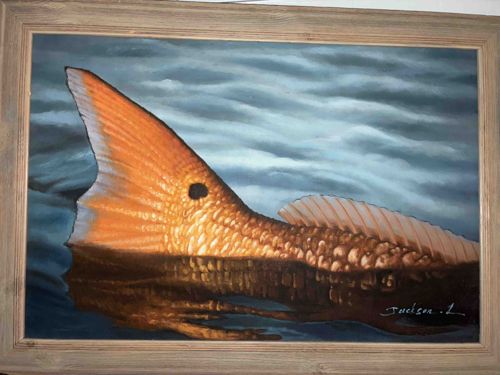
Original Oil Painting of a Tailing Redfish by Jackson L.

Fine Art - Paintings

AI Estimated Value

·Not an official valuation·Verify before acting

$1,200 - $1,850

As of May 27, 2026

AI Item Analysis

·AI can make mistakes·Verify before acting
This is an original oil painting on canvas depicting the tail and dorsal fin of a Red Drum (Redfish) 'tailing' in shallow water. The artwork showcases a vibrant orange-gold palette for the fish's scales and fins, contrasting against a moody, deep-blue and grey undulating water surface. A prominent feature is the realistic depiction of the species' characteristic black ocellus (eye spot) on the caudal fin. The artist, signed as 'Jackson L.' in the lower right corner, has utilized a blend of impasto techniques for the textured scales and smooth glazing for the water's reflection. The piece is housed in a contemporary driftwood-style wooden frame with a weathered grey-brown finish, which complements the coastal subject matter. The craftsmanship exhibits high attention to biological detail, specifically in the translucency of the fin rays and the reflective quality of the submerged body. The painting appears to be in excellent condition with no visible signs of cracking, fading, or surface abrasions, likely dating from the late 20th to early 21st century. The style is representative of modern sporting art or coastal realism.


AI Appraisal Report

·AI can make mistakes·Verify before acting
I have virtually examined this original oil on canvas by 'Jackson L.' depicting the tailing ritual of a Red Drum. The work is a superior example of contemporary sporting art, characterized by a sophisticated play between the heavy impasto on the fish’s scales and the atmospheric glazing of the water. The artist demonstrates a high degree of biological accuracy, particularly in the rendering of the ocellus and the subcutaneous golden hues of the tail, which are highly prized by collectors of coastal realism. Condition appears excellent from this visual survey; I find no evidence of craquelure, paint loss, or stretcher marks. The choice of a driftwood-style frame enhances the aesthetic appeal for the primary market—typically coastal enthusiasts and angling collectors. The market for high-quality sporting art remains robust, with specific demand for 'behavioral' depictions like tailing fish, which offer more dynamism than traditional profile views. Comparables for mid-career artists in this genre usually range between $1,000 and $3,000 depending on size and exhibition history. Limitations: This appraisal is based solely on digital imagery. A definitive authentication requires an in-person inspection to verify the tactile nature of the impasto, examine the canvas reverse for age-appropriate oxidation, and verify the signature consistency under UV light. To solidify this valuation, I recommend the client provide provenance documentation or an exhibition history for Jackson L. Scientific testing (such as pigment analysis) is not currently warranted, but a physical examination of the frame’s construction and canvas tacking would confirm the estimated late 20th/early 21st-century origin.

Get your items appraised

Instant estimates of your treasures with AI-powered appraisals

Browse More Appraisals