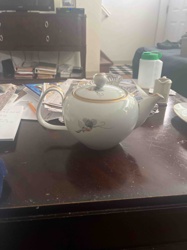
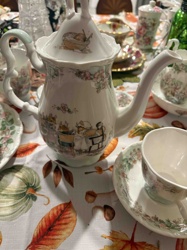
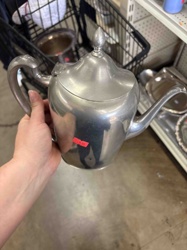
WM. A. Rogers teapot, at least 60 years old by Oncida LTD. Silversmiths
These notes were written by the person who submitted this item. Appraiser.AI has not verified them, and the AI's identification and estimate may rely on them.
AI Estimated Value
Not an official valuation
$40 - $70
AI estimate as of December 2, 2025 · verify with a professional before acting
AI-Generated · Verify before acting
Everything on this page is generated by AI for informational purposes only. AI can make mistakes — the AI may misidentify items or misattribute them (artist, maker, brand, designer, origin, era). This is not an official valuation and should not be used for insurance, sale, tax, estate, legal, or lending purposes — or any decision requiring a certified appraisal. It is not an authoritative claim about any person, brand, or rights holder — do not share or rely on it as a factual statement about a third party. Always consult qualified professionals before making financial decisions.
This analysis also relies on unverified notes provided by the user, which may be incomplete or inaccurate and could affect the result.
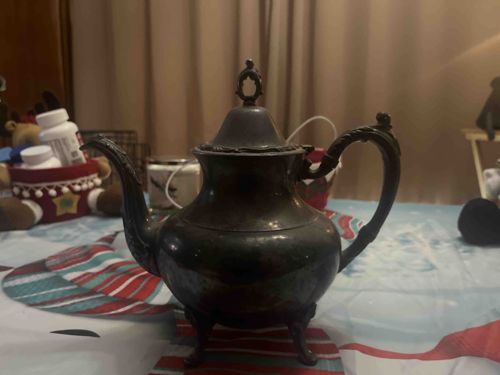
This item is identified as a WM. A. Rogers teapot, manufactured by Oneida Ltd. Silversmiths, and is at least 60 years old based on the provided context. The teapot exhibits a classic and somewhat ornate design, consistent with vintage silver-plated items. It features a dark, tarnished appearance, suggesting it is made of silver-plated metal, likely over a base metal such as brass or nickel silver. The body of the teapot has a bulbous, slightly squat form, resting on three ornate, cabriole-style legs with scrolled feet, which contribute to its traditional aesthetic. The handle is an elegant, C-scroll shape, appearing to have decorative twisted or reeded detailing along its length, terminating in a small finial at its upper attachment point to the body. The spout is gracefully curved and extends outward from the lower portion of the body. The lid is domed with a decorative finial at its apex, designed with an openwork or quatrefoil-like detail at its peak. A subtle, possibly reeded or gadrooned band is visible around the rim of the lid where it meets the body. The overall condition shows significant tarnish, indicating a lack of recent polishing and suggesting its age. There are no readily visible dents, scratches, or egregious damage in the provided images, although a thorough physical inspection would be required to confirm this. The tarnish has created a dark patina, which some collectors appreciate for its historical appearance, while others might prefer it polished to reveal its original luster. The craftsmanship appears to be of a good standard, typical for reputable silversmiths like WM. A. Rogers, with well-formed details on the handle, legs, and finial.
AI Appraisal Report
I have examined the provided image and information for this WM. A. Rogers teapot, manufactured by Oneida Ltd. Silversmiths, and noted to be at least 60 years old. Visually, the teapot presents with a classic vintage silver-plated aesthetic, featuring a bulbous body, three ornate cabriole legs, a graceful C-scroll handle with reeded details, a curved spout, and a domed lid topped with an openwork finial. The overall condition, based on the image, shows significant tarnish, consistent with its age and silver-plated nature. This tarnish, while obscuring the original luster, does not appear to indicate deep structural issues. I observe no obvious dents or significant damage; however, a physical inspection would be crucial to confirm the absence of subtle dents, scratches, plate loss, or repairs. Authenticity as a WM. A. Rogers product by Oneida Ltd. is accepted based on the provided information, although full authentication would necessitate examining maker's marks, which are not visible in the image. The demand for vintage silver-plated teapots, particularly those by makers like WM. A. Rogers, is generally moderate. They are not considered rare, with many examples available in the secondary market. Factors impacting value include the silver plate condition (significant plate loss would devalue it), the integrity of all components (no missing pieces, tight handle/spout attachments), and the appeal of the specific design. While the ornate style is pleasant, it doesn't command premium prices unless it possesses exceptional rarity or historical significance, which this piece does not appear to. The value reflects its attractive vintage decorative appeal rather than intrinsic material worth or extreme rarity. In-person examination would be required to verify plate thickness, assess any potential repairs disguised by tarnish, and confirm marks. Without these, my assessment is based solely on visual aesthetics and typical market trends for such items.