These notes were written by the person who submitted this item. Appraiser.AI has not verified them, and the AI's identification and estimate may rely on them.
AI Estimated Value
Not an official valuation
$30-60
AI estimate as of September 23, 2025 · verify with a professional before acting
AI-Generated · Verify before acting
Everything on this page is generated by AI for informational purposes only. AI can make mistakes — the AI may misidentify items or misattribute them (artist, maker, brand, designer, origin, era). This is not an official valuation and should not be used for insurance, sale, tax, estate, legal, or lending purposes — or any decision requiring a certified appraisal. It is not an authoritative claim about any person, brand, or rights holder — do not share or rely on it as a factual statement about a third party. Always consult qualified professionals before making financial decisions.
This analysis also relies on unverified notes provided by the user, which may be incomplete or inaccurate and could affect the result.
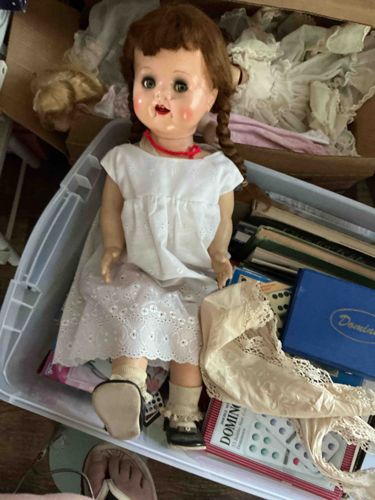
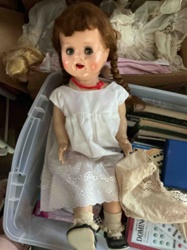
This is a vintage doll, likely constructed from hard plastic or composition material, featuring a light flesh-toned complexion. The doll has a molded head with painted facial features, including rosy cheeks, red lips formed in an open-mouthed smile, and what appear to be either green or brown sleep eyes with eyelashes. Her hair is a reddish-brown color, styled in bangs across the forehead and two long, tightly braided pigtails. She is wearing a simple white short-sleeved dress with eyelet embroidery detailing on the skirt, and a red beaded or ribbon necklace around her neck. On her feet are tan ruffled socks and black mary-jane style shoes with white soles. The doll's limbs appear to be jointed, suggesting a common construction for dolls of the mid-20th century. There are some visible signs of wear, particularly on the face, where there are scuffs or dirt marks, especially around the nose and mouth area, indicating age and handling. The material also shows some shininess, which could be due to age-related patina or previous cleaning attempts. The dress seems to be in relatively good condition, though it may benefit from cleaning. There are no clear manufacturer's marks or signatures visible in the provided images, making precise dating challenging without further inspection; however, based on its aesthetics and construction, it likely dates from the 1940s to 1960s. The overall craftsmanship is typical for mass-produced dolls of that era, prioritizing durability and playability. The doll exudes a charming, classic vintage appeal.
AI Appraisal Report
I have carefully examined the provided image of this vintage hard plastic or composition doll with braids. Based on its construction, molded features, and overall aesthetic, I agree with the owner's assessment that it likely dates from the 1940s to 1960s. The doll presents with a classic vintage charm, typical of mass-produced play dolls from that era.
The condition of the doll is fair to good. The hard plastic or composition material shows visible scuffs and dirt marks, particularly on the face around the nose and mouth, consistent with age and play. The material also exhibits some shininess, which could be an age-related patina or the result of prior cleaning. The clothing, a simple white eyelet dress, appears to be in relatively good condition, though a cleaning would be beneficial. The reddish-brown braided hair and painted features are intact, and the sleep eyes appear functional. The jointed limbs are a common feature for this period.
Several factors impact its value. While it possesses vintage appeal, the lack of a discernible manufacturer's mark significantly limits its potential value, as many collectors prioritize identified makers. The common construction and mass-produced nature also mean it's not particularly rare. Comparable dolls in similar condition, without specific manufacturer identification, typically sell in the $30 to $60 range. Dolls from this era by well-known makers (e.g., Ideal, Madame Alexander, American Character) in excellent condition with original tags can fetch more, but this doll does not appear to fall into that category given the available information.
To fully authenticate and precisely date the doll, an in-person examination would be critical to check for any hidden manufacturer marks on the body, head, or under the clothing. Physical inspection would also allow for a more accurate assessment of the material composition, the functionality of the sleep eyes, and a detailed evaluation of wear and potential repairs. Provenance documentation, such as original sales receipts or family history, while unlikely for such a common item, would also be beneficial for full authentication. Without these, the value remains in the range for a charming, unidentified vintage play doll.