AI estimate as of July 26, 2025 · verify with a professional before acting
AI-Generated · Verify before acting
Everything on this page is generated by AI for informational purposes only. AI can make mistakes — the AI may misidentify items or misattribute them (artist, maker, brand, designer, origin, era). This is not an official valuation and should not be used for insurance, sale, tax, estate, legal, or lending purposes — or any decision requiring a certified appraisal. It is not an authoritative claim about any person, brand, or rights holder — do not share or rely on it as a factual statement about a third party. Always consult qualified professionals before making financial decisions.
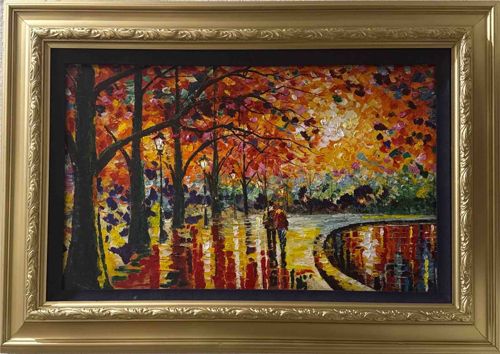
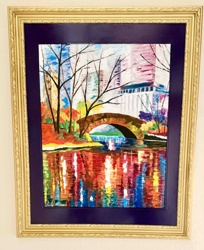
The item is an oil painting or acrylic painting on canvas, characterized by a highly textured, impasto style, giving it a three-dimensional quality. The dominant colors include vivid oranges, reds, yellows, and browns for the autumn foliage, contrasted with dark greens and blues for trees and the water, and splashes of white and light yellow for illumination and reflections. The scene depicts a park or promenade in autumn, with a path winding alongside a body of water, possibly a pond or river. On the left side, several dark, silhouetted tree trunks with vibrant autumnal leaves are visible. Two streetlights with glowing white orbs punctuate the scene, suggesting a dusk or evening setting. In the middle ground, near the water's edge, two figures appear to be walking, their forms suggested by broad strokes of color. The water reflects the vibrant colors of the trees and surrounding light sources, creating abstract, shimmering patterns. The painting technique involves distinct, thick brushstrokes, with minimal blending, allowing individual dabs of color to contribute to the overall impressionistic effect. This technique is often associated with the Impressionist or Post-Impressionist periods, although specific artists often employ such styles in contemporary works. The painting is housed within a substantial, ornate gilded frame. The frame features traditional decorative molding with a leaf or scroll motif, adding to its classical appearance. There appears to be a dark 'liner' or 'fillet' between the painting and the inner edge of the frame, providing a visual separation and depth. No visible artist's signature or specific markings are discernible in the provided image. The overall condition appears good, with no obvious signs of damage, tears, or significant paint loss; the impasto texture is likely intentional and well-preserved. The frame also appears to be in good condition, with no visible chips or significant wear to the gilding. Given the stylistic elements, it could be a contemporary work inspired by historical art movements, or a more recent piece adhering to traditional landscape painting conventions.
AI Appraisal Report
Upon visual examination of the provided image, I have assessed this Autumn Park Scene Impasto Painting. The artwork is an oil or acrylic on canvas, notable for its heavy impasto technique, which creates significant texture and a three-dimensional effect. The subject, a classic autumnal park scene at dusk, is rendered in an impressionistic style with vibrant, unblended colors and dramatic light from streetlamps reflected on water. The painting appears to be in excellent condition, with no visible cracking, paint loss, or damage; the ornate gilded frame is also in good condition.
The style is reminiscent of popular contemporary decorative art rather than a work by a historically significant artist. The lack of a visible signature is a key factor. Without an attributable artist, the painting is valued as a decorative piece. The market for unsigned, aesthetically pleasing landscape paintings like this is consistent, driven by interior design trends. Comparable works are frequently found in art galleries and online art marketplaces, typically sold based on size, decorative appeal, and quality of execution rather than an artist's reputation.
The primary factor limiting the value is the anonymity of the artist. For a definitive appraisal, a physical, in-person examination would be essential to inspect the reverse of the canvas for any markings, labels, or signatures, and to assess the true age of the materials. Full authentication would require establishing provenance (history of ownership) or, in the absence of a signature, comparative analysis by an expert in a specific artist's work if a potential attribution were to arise. At present, it is appraised as a high-quality decorative work.