AI estimate as of July 24, 2025 · verify with a professional before acting
AI-Generated · Verify before acting
Everything on this page is generated by AI for informational purposes only. AI can make mistakes — the AI may misidentify items or misattribute them (artist, maker, brand, designer, origin, era). This is not an official valuation and should not be used for insurance, sale, tax, estate, legal, or lending purposes — or any decision requiring a certified appraisal. It is not an authoritative claim about any person, brand, or rights holder — do not share or rely on it as a factual statement about a third party. Always consult qualified professionals before making financial decisions.
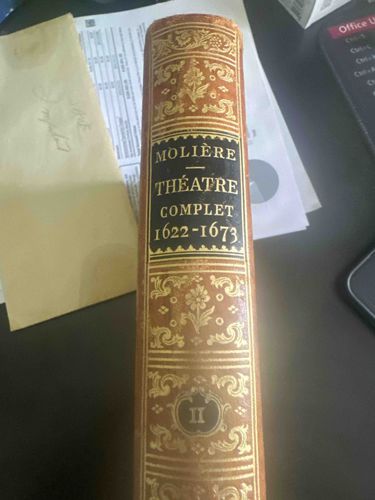
The item is a bound book, specifically volume 'II' as indicated by the Roman numeral 'II' prominently displayed within an oval cartouche on the lower section of the spine. The spine is crafted from what appears to be leather, tanned to a warm, medium brown color, and features rich gold tooling. The gold decoration is intricate, depicting a series of ornate floral and scroll motifs that divide the spine into several compartments. One central compartment, distinguished by its black background, features the text 'MOLIÈRE', 'THÉÂTRE', 'COMPLET', and the date range '1622-1673' in gold lettering. This suggests the book contains the complete theatrical works of Molière, published in a historical context. The tooling is precise, indicating high-quality craftsmanship consistent with fine binding practices. The surface of the leather shows some natural wear and minor scuffing, particularly along the raised bands and edges, which is typical for an older volume. There's a slight loss of some gold gilt in areas due to age and handling, but the overall design remains clear and vibrant. The binding appears to be a half-leather or full-leather binding, given the uniform appearance of the spine. The paper visible to the left of the book might be part of an endpaper or a piece of ephemera laid within the volume, showing some creasing. The book's style, particularly the elaborate gold tooling and the subject matter, points to a potential publication period in the 19th or early 20th century, though a more precise date would require examining the title page or publication information within the book itself. The condition suggests it has been well-preserved despite its age, retaining much of its aesthetic appeal.
AI Appraisal Report
I have examined the image provided for this Molière Théâtre Complet, Volume II. The book appears to be a well-preserved volume with a particularly attractive leather spine featuring intricate gold tooling, typical of fine binding practices. The Roman numeral 'II' in an oval cartouche and the titles "MOLIÈRE," "THÉÂTRE," "COMPLET," and “1622-1673” in gold lettering on a black ground indicate this is a volume from a set of Molière's complete theatrical works.
Based on the visual evidence, the condition is good, showing expected wear for its age, including minor scuffing and slight loss of gilt, but the overall aesthetic appeal is retained. This appears to be an authentic antique volume, likely from the 19th or early 20th century, given the style of binding and tooling. However, authenticity verification from images alone is limited. A full authentication would require physical examination to assess paper quality, binding structure, and internal components like the title page and publication details. Provenance documentation would further confirm its history and authenticity.
Market conditions for fine bindings and classic literary sets remain stable. While Molière's works are commonly available, highly decorative and well-preserved sets like this can be desirable to collectors of literature, fine bindings, or French history. Demand is moderate, driven by collectors seeking aesthetically pleasing and historically significant editions. The primary value drivers are the quality of the binding, its state of preservation, and its completeness within the set (though only one volume is shown). Rarity is dependent on the specific edition and printer; without internal details, this cannot be fully assessed.
The presence of an original, decorative binding significantly enhances its value compared to a mere textual reprint. The detailed tooling and relatively good condition trotz its age makes it an attractive collectible.
For a more precise valuation, I would need to physically inspect the book to determine the exact publication details (publisher, date, edition), assess the condition of the text block (foxing, tears, completeness), and confirm the binding material (is it full or half leather?). Scientific testing could confirm the age of the leather or paper, if necessary. Without these, the appraisal remains based on visual aesthetic and general market trends for similar items.