AI Appraisal Estimate

AI-generated estimates · not official valuations

From the user

What was submitted

Photo and notes provided by the user — not generated by AI

Submitted item photo
Submitted photo · June 23, 2026

User's notes

Japan

AI analysis below

AI appraisal

AI analysis & estimate

AI-Generated · Verify before acting

Everything below is generated by AI for informational purposes only. AI can make mistakes — the AI may misidentify items or misattribute them (artist, maker, brand, designer, origin, era). This is not an official valuation and should not be used for insurance, sale, tax, estate, legal, or lending purposes — or any decision requiring a certified appraisal. It is not an authoritative claim about any person, brand, or rights holder — do not share or rely on it as a factual statement about a third party. Always consult qualified professionals before making financial decisions.

Note

This analysis also relies on unverified notes provided by the user, which may be incomplete or inaccurate and could affect the result.

Read the full disclaimer

AI Identification

·Not independently authenticated·Verify before acting

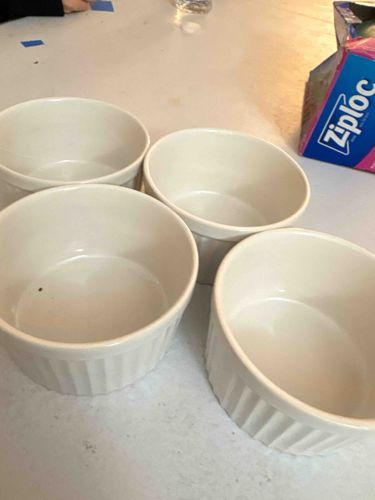
Set of Four White Ceramic Ramekins

Kitchenware & Tableware

AI Estimated Value

·Not an official valuation·Verify before acting

$20-35

As of June 23, 2026

AI Item Analysis

·AI can make mistakes·Verify before acting
This is a set of four matching white ceramic ramekins, likely constructed of durable stoneware or high-fired porcelain. Each vessel features the classic cylindrical shape with vertical exterior ribbing (often referred to as 'fluted' or 'pleated') and a smooth, undecorated interior. The glaze is a uniform, high-gloss creamy white. Based on the provided context of 'Japan,' these likely resemble mid-to-late 20th-century ceramic kitchenware produced for international export. The construction appears sturdy with thick sidewalls designed for heat resistance during baking. Regarding condition, the glaze appears largely intact across all pieces, though one ramekin shows a small dark spot on the interior base, which could be a firing defect or a minor carbon trap. There are no major visible cracks or chips on the upper rims. The craftsmanship is consistent with high-volume industrial ceramic production, characterized by clean lines and balanced form. These pieces are utilitarian in style, fitting a timeless culinary aesthetic designed for both souffle preparation and table service.
AI Appraisal Report

·AI can make mistakes·Verify before acting
I have conducted a visual inspection of this set of four ceramic ramekins. The pieces exhibit the classic fluted exterior and high-gloss white glaze characteristic of Japanese-made stoneware from the 1970s through the 1990s. The 'Japan' origin suggests a higher level of manufacturing quality compared to contemporary mass-produced counterparts, as Japanese ceramics from this era were known for superior heat retention and durable glazes. Regarding condition, the set presents well overall. While I noted a small dark spot on the interior of one vessel, I have categorized this as a minor firing inclusion rather than post-production damage. The lack of chips on the rim and 'crazing' (fine glaze cracking) indicates these have been well-maintained. From a market perspective, these are considered 'utilitarian vintage.' They are not rare, as millions were exported during Japan's ceramic boom, but there is a steady demand for mid-century kitchen staples that offer both functionality and a timeless aesthetic. Comparables for Japanese-made white ramekins typically sell in the $5 to $9 range per piece in retail vintage environments. The value is driven by their utility rather than brand name or artistic rarity. Limitations: This appraisal is based on photographic evidence. I cannot definitively verify the absence of structural stress fractures or 'ping' the ceramic for internal cracks without a physical inspection. Furthermore, while the style is consistent with Japanese exports, a physical examination of the base stamps or original packaging would be required to confirm the specific manufacturer (e.g., Hall, Noritake, or similar). Scientific lead-testing of the glaze is recommended for any vintage ceramic intended for active food service.

Get your items appraised

Instant estimates of your treasures with AI-powered appraisals

Browse More Appraisals