AI estimate as of September 18, 2025 · verify with a professional before acting
AI-Generated · Verify before acting
Everything on this page is generated by AI for informational purposes only. AI can make mistakes — the AI may misidentify items or misattribute them (artist, maker, brand, designer, origin, era). This is not an official valuation and should not be used for insurance, sale, tax, estate, legal, or lending purposes — or any decision requiring a certified appraisal. It is not an authoritative claim about any person, brand, or rights holder — do not share or rely on it as a factual statement about a third party. Always consult qualified professionals before making financial decisions.
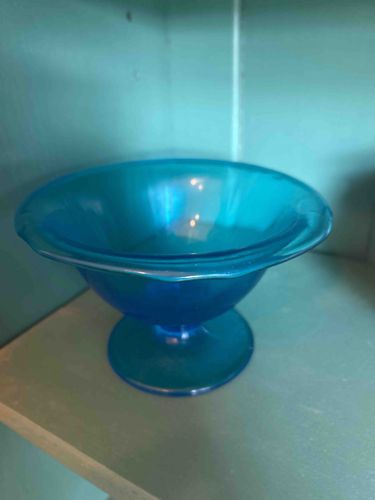
This item is a turquoise blue glass pedestal bowl, likely intended as a dessert dish, compote, or possibly a decorative candy dish. It is constructed from a vibrant, translucent blue glass that presents a slightly deeper, more saturated blue in the bowl's lower sections and a lighter, more aqua hue towards the rim. The bowl features a wide, shallow, and gently flared rim, which transitions smoothly into a rounded, tapering body. This body then narrows down to a distinct stem which connects to a stable, circular foot or base. The overall form suggests a classic design, possibly dating from the mid-20th century, though without specific markings, an exact age is difficult to ascertain. The glass appears to be uniformly colored and free of visible inclusions or bubbles, indicating reasonable quality manufacturing. The surface is smooth and reflective, showing some light reflections from the surroundings. There are no obvious chips, cracks, or repairs visible in the provided image. Fine scratches or minor wear consistent with age and use might be present but are not discernible. The craftsmanship appears to be standard for mass-produced glassware of its type, aiming for functionality and aesthetic appeal through its striking color. The rim has a subtle thickness, suggesting durability, and the connection points between the bowl, stem, and foot appear seamless, indicating a well-formed piece.
AI Appraisal Report
Upon visual examination of the provided image, this turquoise blue glass pedestal bowl appears to be in excellent condition. There are no discernible chips, cracks, or repairs, and the surface reflectivity suggests minimal scuffing. The color saturation and gradient from a deeper blue to a lighter aqua are aesthetically pleasing. Authenticity, based solely on imagery, points towards a mass-produced item, likely from the mid-20th century, consistent with standard glassware manufacturing of that era. Without specific maker's marks or provenance, attributing it to a particular manufacturer or ensuring its age definitively is not possible.
Market conditions for colored depression-era or mid-century glass compotes are generally stable but not exceptionally strong for unmarked pieces. This item's primary value driver is its vibrant color and good condition. Comparable items, such as Fenton, Viking, or similar mid-century colored glass compotes without rare patterns or unique features, typically retail in the $20-$50 range, depending on size and specific market visibility. Demand for such pieces is moderate, appealing to collectors of vintage glassware or those seeking decorative accents. Rarity is low, as similar items were produced in large quantities.
Factors significantly impacting value are primarily its good condition and attractive color. The lack of identifiable maker's marks, pattern, or historical significance limits its upper value. For full authentication and a more precise valuation, an in-person examination would be crucial to assess tactile qualities, exact weight, and to search for any subtle marks not visible in the image. Provenance documentation would confirm its history, and scientific testing (e.g., spectroscopy) could confirm glass composition and age, although this is rarely performed for items of this estimated value.