AI Appraisal Estimate

AI-generated estimates · not official valuations

From the user

What was submitted

Photo and notes provided by the user — not generated by AI

Submitted item photo
Submitted photo · May 30, 2026

User's notes

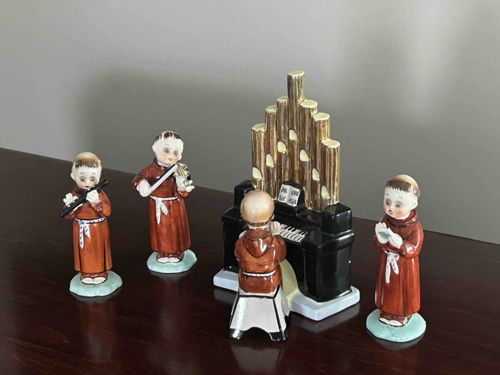
5 piece monk set

AI analysis below

AI appraisal

AI analysis & estimate

AI-Generated · Verify before acting

Everything below is generated by AI for informational purposes only. AI can make mistakes — the AI may misidentify items or misattribute them (artist, maker, brand, designer, origin, era). This is not an official valuation and should not be used for insurance, sale, tax, estate, legal, or lending purposes — or any decision requiring a certified appraisal. It is not an authoritative claim about any person, brand, or rights holder — do not share or rely on it as a factual statement about a third party. Always consult qualified professionals before making financial decisions.

Note

This analysis also relies on unverified notes provided by the user, which may be incomplete or inaccurate and could affect the result.

Read the full disclaimer

AI Identification

·Not independently authenticated·Verify before acting

Vintage 5-Piece Porcelain Musical Friar Monk Figurine Set

Collectibles - Decorative Figurines

AI Estimated Value

·Not an official valuation·Verify before acting

$45.00 - $65.00

As of May 30, 2026

AI Item Analysis

·AI can make mistakes·Verify before acting
This is a charming five-piece set of porcelain figurines depicting a group of friar monks engaged in a musical performance, likely of Japanese origin from the mid-20th century (circa 1950s-1960s). The set includes a central organist seated at a black and gold pipe organ, accompanied by four standing monks: one playing a violin, one playing a flute, and others appearing to sing or hold sheet music. The figures are characterized by their brown habits with white knotted rope belts (cinctures), tonsured hair, and expressive, oversized eyes consistent with 'Goebel-style' or 'M.I. Hummel' influence popular during that era. Each figure stands on a light blue-green base. Dimensions generally range from 3 to 5 inches in height for the standing figures, with the organ being the tallest piece. The construction is glazed ceramic with hand-painted details. Notably, the pipe organ features metallic gold-tone highlights on the pipes and white sheet music detail. The condition appears to be excellent with no visible chips, cracks, or significant crazing, though minor surface dust and typical shelf wear on the unglazed bottom surfaces are expected. This set exemplifies post-war kitsch collectible ceramics, often imported by companies like Napco or Lefton, showcasing high-gloss finishes and whimsical, religious-themed folk art.
AI Appraisal Report

·AI can make mistakes·Verify before acting
I have carefully examined the provided images and descriptions of this five-piece vintage porcelain musical friar monk set. The set exhibits the high-gloss glaze and whimsical aesthetic characteristic of mid-century Japanese imports, likely produced by firms such as Napco, Lefton, or Japan-based manufacturers for the export market during the 1950s and 1960s. The condition appears to be excellent; the lack of visible chips on high-point areas like the cowls and instruments significantly preserves its secondary market value. The colors remain vibrant, and the hand-painted detailing on the faces is consistent with mid-tier collector ceramics of the era. The current market for 'Friar Monk' collectibles is stable but niche. While 'Goebel' or 'Hummel' items command higher premiums due to brand recognition, these Japanese interpretations are valued more for their kitsch appeal and decorative charm. Comparable sales for complete 5-piece sets in similar condition typically fall within the $45 to $65 range. The presence of the organist—the most complex piece in the set—is a critical factor in maintaining this valuation, as individual pieces are often lost or damaged over time. Limitation: This appraisal is based solely on digital images. Without an in-person inspection, I cannot verify the presence of subtle professional repairs or internal hairline fractures not visible under standard lighting. Authentic identification would require checking for backstamps or foil stickers (e.g., 'Japan' or 'Napco') on the unglazed bases. A physical examination under a long-wave UV light would be necessary to confirm the absence of overpainting or restoration efforts that could affect the final valuation.

Get your items appraised

Instant estimates of your treasures with AI-powered appraisals

Browse More Appraisals