These notes were written by the person who submitted this item. Appraiser.AI has not verified them, and the AI's identification and estimate may rely on them.
AI Estimated Value
Not an official valuation
$600-900
AI estimate as of August 13, 2025 · verify with a professional before acting
AI-Generated · Verify before acting
Everything on this page is generated by AI for informational purposes only. AI can make mistakes — the AI may misidentify items or misattribute them (artist, maker, brand, designer, origin, era). This is not an official valuation and should not be used for insurance, sale, tax, estate, legal, or lending purposes — or any decision requiring a certified appraisal. It is not an authoritative claim about any person, brand, or rights holder — do not share or rely on it as a factual statement about a third party. Always consult qualified professionals before making financial decisions.
This analysis also relies on unverified notes provided by the user, which may be incomplete or inaccurate and could affect the result.
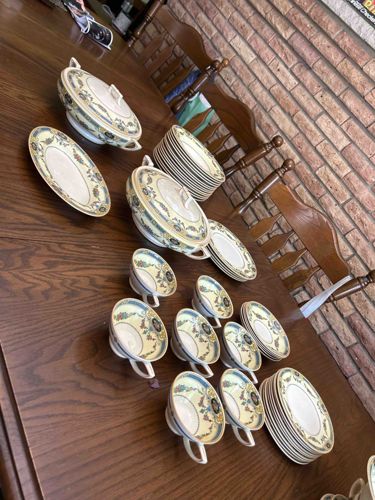
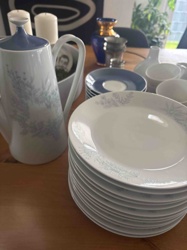
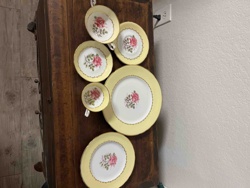
This is a substantial vintage dinnerware set, identified as 'Royal Myotts Crown Staffordshire England'. The set appears to be made of fine porcelain or bone china, known for its translucence and durability. The dominant color scheme is a light cream or ivory base with intricate decorative patterns in shades of blue, yellow, and possibly some faded red or orange highlights, outlined in what looks like a gilded finish. The pattern features ornate floral and foliate motifs, possibly in an Imari style or a similar sophisticated Chinoiserie aesthetic, with a central cartouche or medallion on many pieces. There are several different types of pieces visible, including lidded serving dishes (likely a soup tureen and a covered vegetable dish), individual plates (stacked, indicating possibly dinner plates or salad plates), and numerous teacups or coffee cups with matching saucers. The lidded pieces have integrated handles. The individual cups have a classical shape with small, elegant handles. The overall condition appears to be good for its age, though specific close-ups of individual pieces for wear, crazing, or chips are not available. The gilded accents, if present, are a strong indicator of quality and craftsmanship, characteristic of Staffordshire pottery from the early to mid-20th century. The 'Crown Staffordshire' mark suggests a connection to a reputable English pottery manufacturer, indicating a potential age range from the early 1900s to the 1970s. No specific maker's marks or signatures are visible in the provided images.
AI Appraisal Report
Upon examining the provided images and details, I assessed this 'Royal Myotts Crown Staffordshire England' dinnerware set. The overall impression is one of a substantial, vintage set. Visually, the condition appears good for its age; however, I must emphasize that without close-up inspection, it's impossible to confirm the absence of common issues such as hairline cracks, chips, crazing, or loss to the gilded accents. These factors significantly impact value.
From the visual evidence, the pattern suggests an Imari or Chinoiserie style, indicative of quality craftsmanship. The presence of lidded serving dishes, various plates, and numerous cups and saucers points to a comprehensive set, which generally holds more value than incomplete collections. The 'Crown Staffordshire' mark is well-regarded, suggesting a manufacture period from the early 20th century to possibly the 1970s.
Market conditions for vintage dinnerware like this can fluctuate. Sets from known manufacturers like Staffordshire generally maintain interest, especially those with intricate patterns and gilded elements. Demand is moderate, driven by collectors, those furnishing period homes, or individuals seeking unique aesthetic pieces. Rarity is difficult to ascertain purely from images, but comprehensive sets in good condition are less common than individual pieces.
Factors significantly impacting value include the precise number of pieces, confirmation of 'Royal Myotts' as an official line under Crown Staffordshire (which is typically 'Myott' or 'Crown Staffordshire' separately, suggesting a need for brand clarification), and the actual condition of the gilding and porcelain. For full authentication and to ascertain the exact manufacturer and pattern name, I would need to physically examine the backstamps on several pieces, and potentially research production records or historical pattern guides. Without physical inspection, provenance documentation, or scientific material testing, a definitive authentication of age, origin, and specific series cannot be fully guaranteed. Any valuation carries this limitation.