AI estimate as of July 26, 2025 · verify with a professional before acting
AI-Generated · Verify before acting
Everything on this page is generated by AI for informational purposes only. AI can make mistakes — the AI may misidentify items or misattribute them (artist, maker, brand, designer, origin, era). This is not an official valuation and should not be used for insurance, sale, tax, estate, legal, or lending purposes — or any decision requiring a certified appraisal. It is not an authoritative claim about any person, brand, or rights holder — do not share or rely on it as a factual statement about a third party. Always consult qualified professionals before making financial decisions.
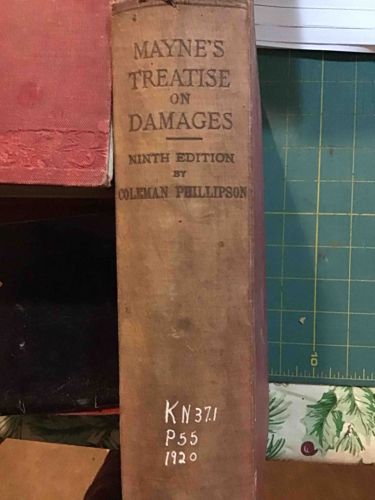
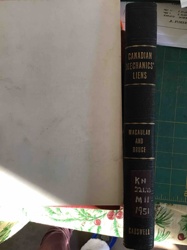
The item is a vintage legal treatise, specifically identified as 'Mayne's Treatise on Damages, Ninth Edition by Coleman Phillipson.' The book features a sturdy, somewhat faded binding, likely constructed from a durable material such as buckram or thick cloth, consistent with legal texts designed for longevity. The color of the spine is a muted reddish-brown or tan, showing signs of age and handling, including some discoloration and minor scuff marks. The title and author information are printed directly onto the spine in black or very dark ink, which has also faded slightly over time, but remains legible. Below the author's name, there is a clear handwritten inscription in white or light-colored ink, which appears to be a library or cataloging call number: 'KN371 / P55 / 1920'. This suggests the book was once part of a collection and points to its publication year being 1920. The overall condition suggests regular use, typical for a working legal reference, with visible wear along the edges and corners, indicating the book has been frequently handled and perhaps stored in various environments. The spine shows a slight concavity, suggesting the weight of the pages and gravitational pull over many years. No rips or major tears are immediately visible on the spine, suggesting the binding remains largely intact, though its structural integrity beyond what's visible cannot be fully ascertained from the image alone. The book exhibits good craftsmanship for a functional legal text of its era, intended for utility rather than ornate display. Its age places it squarely in the early 20th century.
AI Appraisal Report
Upon examining the provided image of 'Mayne's Treatise on Damages, Ninth Edition by Coleman Phillipson (1920),' I assess its condition as fair to good for its age. The clear signs of wear, fading, and scuffing on the binding are consistent with regular use typical of a legal reference; however, the binding appears largely intact with no visible major tears. The handwritten call number 'KN371 / P55 / 1920' adds a layer of authenticity regarding its former life in a collection and corroborates the publication year.
From my perspective, the authenticity of the item as a 1920 Ninth Edition appears strong based on the visual evidence and bibliographical consistency. However, a full authentication would require in-person examination to verify paper quality, printing methods, and binding integrity more thoroughly. Provenance documentation, beyond the visible call number, would further establish its history and authenticity.
Regarding market conditions, legal treatises from this era, while historically significant, generally do not command high prices unless they are first editions of groundbreaking works or have unique historical association. This specific edition is a standard reference work for its time. Comparable sales of similar early 20th-century legal texts in similar condition typically range from $25 to $75. Demand for such specific, non-rare legal texts is niche, primarily appealing to legal historians, academic libraries, or collectors of specific legal disciplines. Its rarity is moderate; while not mass-produced like modern paperbacks, it was a foundational text, so many copies were printed.
Factors impacting value include its age, its legible but worn condition, and its functional rather than decorative nature. The lack of any significant historical signatures or unique features also limits its higher-end valuation. Without physical inspection to confirm the internal condition (e.g., foxing, annotations, loose pages) and the overall structural soundness, I must err on the conservative side.