AI estimate as of September 22, 2025 · verify with a professional before acting
AI-Generated · Verify before acting
Everything on this page is generated by AI for informational purposes only. AI can make mistakes — the AI may misidentify items or misattribute them (artist, maker, brand, designer, origin, era). This is not an official valuation and should not be used for insurance, sale, tax, estate, legal, or lending purposes — or any decision requiring a certified appraisal. It is not an authoritative claim about any person, brand, or rights holder — do not share or rely on it as a factual statement about a third party. Always consult qualified professionals before making financial decisions.
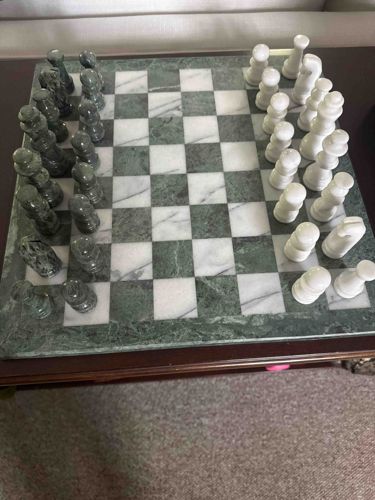
This is a full marble chess set featuring a chess board and two complete sets of chess pieces. The chess board is constructed from polished marble squares, alternating between white with grey veining and dark green with lighter green and white veining. The board appears to be approximately 12-15 inches per side based on the visible parts, and it has a solid, substantial feel, indicating thick marble slabs. The edges of the board appear to have a dark, possibly wooden or stained wooden trim, providing a finished look and potentially offering some protection to the marble. One set of chess pieces is carved from white marble, consistent with the white squares, displaying subtle grey veining. The opposing set is carved from dark green marble, matching the green squares, also showing natural variations in color. The pieces are hand-carved, exhibiting classical Staunton-style forms, though with a somewhat simplified and slightly rustic aesthetic, typical of marble or stone carved sets. The craftsmanship appears decent, with smooth surfaces, but some pieces might show minor irregularities due to the hand-carved nature of the stone. There are no visible chips, cracks, or significant damage to the pieces or the board, suggesting good preservation. However, it's difficult to assess the underside or very specific details from the provided image. The set is likely a modern or late 20th-century production, valued more for its decorative appeal and material quality than for intricate historical craftsmanship. The natural variations in the marble give each piece and the board a unique character. This type of chess set is often purchased for both play and as a sophisticated decorative object, suggesting it has been well cared for.
AI Appraisal Report
Upon visual examination of the provided image, I assess this full marble chess set. The condition appears to be very good; I observe no visible chips, cracks, or significant damage to either the polished marble board or the hand-carved pieces. The alternating white and dark green marble, with their natural veining, contribute to a sophisticated aesthetic. The board's dark trim adds a refined finish. The chess pieces, in classical Staunton-style, exhibit a slightly rustic charm typical of stone-carved sets, and their craftsmanship seems decent, though minor irregularities are expected with hand-carved stone.
Authenticity, in terms of material, is clear: this is indeed marble. However, the set's precise age and origin cannot be definitively determined from imagery alone. It appears to be a modern or late 20th-century production, valued more for its decorative appeal and material quality than for historical craftsmanship.
Market conditions for such marble chess sets are stable. Comparables typically sell in the range of $100-$300, depending on size, specific marble quality, and carving intricacy. Demand for these sets is moderate, driven primarily by those seeking decorative accoutrements or functional, aesthetically pleasing game sets. Rarity is not a significant factor here; similar new and used marble sets are readily available. The primary value drivers are the solid marble construction, good condition, and decorative appeal.
Limitations: My assessment of condition is based solely on visible surfaces in the image. I cannot inspect the undersides of the board or pieces for potential damage or maker's marks. For full authentication of age or specific origin, an in-person examination, including tactile inspection for craftsmanship details, assessment of material wear not visible in images, and potential examination for provenance documentation, would be necessary.