AI estimate as of July 25, 2025 · verify with a professional before acting
AI-Generated · Verify before acting
Everything on this page is generated by AI for informational purposes only. AI can make mistakes — the AI may misidentify items or misattribute them (artist, maker, brand, designer, origin, era). This is not an official valuation and should not be used for insurance, sale, tax, estate, legal, or lending purposes — or any decision requiring a certified appraisal. It is not an authoritative claim about any person, brand, or rights holder — do not share or rely on it as a factual statement about a third party. Always consult qualified professionals before making financial decisions.
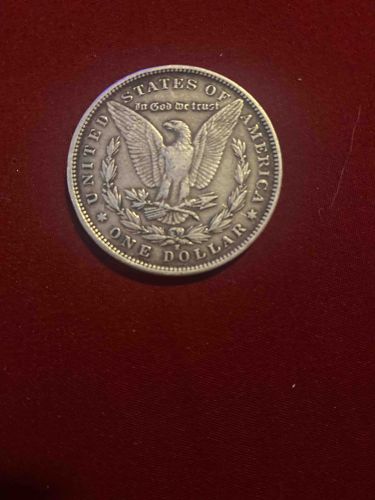
The item is a silver coin, depicting the reverse side of what appears to be a Morgan Dollar. The central motif is a large, heraldic eagle with outstretched wings, clutching an olive branch in its right talon and arrows in its left, symbolizing peace and preparedness. Above the eagle's head, within a sunburst or glory, is the motto "In God We Trust." A wreath of laurel or olive branches encircles the lower half of the eagle. The inscription "UNITED STATES OF AMERICA" is prominently displayed along the top rim, while "ONE DOLLAR" is curved along the bottom rim. Each word in the lower inscription is separated by a five-pointed star. The rim of the coin features a series of fine, distinct denticles or beads, indicating a reeded edge. The coin exhibits a uniform, dull silver-gray patina, suggesting some age and natural toning consistent with an uncleaned or lightly circulated state. There are visible signs of wear consistent with a circulated coin, such as flattened details on the eagle's feathers and the lettering, typical for coinage of this era. No obvious deep scratches, gashes, or significant damage like bending or major dents are immediately apparent from the image, but surface abrasions or minor nicks might be present upon closer inspection. The overall impression is that of a genuine coinage, likely from the late 19th or early 20th century, given the design characteristics of the Morgan Dollar.
AI Appraisal Report
I have examined the provided image of what appears to be the reverse side of a Morgan Dollar. Based on the visual characteristics, the coin exhibits the correct design elements for a Morgan Dollar reverse: a heraldic eagle, the "In God We Trust" motto, and the "UNITED STATES OF AMERICA" and "ONE DOLLAR" inscriptions. The denticles on the rim also appear consistent.
The condition, as observed from the image, suggests a circulated state. Details on the eagle's feathers and the lettering show flattening, consistent with wear. The uniform dull silver-gray patina points to natural toning rather than harsh cleaning, which is a positive factor. No major damage like bends or deep gashes are evident, though surface abrasions are likely present. I would grade this coin, based solely on the image, in the Very Fine (VF) to Extremely Fine (XF) range.
Regarding market conditions, Morgan Dollars are highly popular and liquid in the numismatic market. Demand remains strong across all grades. Rarity is determined primarily by mint mark and date, which cannot be discerned from this reverse-only image. Without a visible mint mark or date, it is assumed to be a common date issue.
Factors impacting value include its circulated condition, which places it below uncirculated examples. The natural toning is a plus, as harshly cleaned coins are typically devalued.
However, it's crucial to state the limitations of this appraisal. Authenticity verification from an image alone is not definitive. An in-person examination is critical to confirm the coin's weight, diameter, thickness, edge reeding, and absence of counterfeiting indicators such as casting seams or incorrect strike characteristics. Microscopic examination would reveal true surface wear versus artificial aging. Furthermore, provenance documentation would add significant value and verify its history. Scientific testing, like XRF analysis, could confirm metallic composition if concerns about authenticity arose. Without these, the appraisal remains provisional.