These notes were written by the person who submitted this item. Appraiser.AI has not verified them, and the AI's identification and estimate may rely on them.
AI Estimated Value
Not an official valuation
$400-700
AI estimate as of July 20, 2025 · verify with a professional before acting
AI-Generated · Verify before acting
Everything on this page is generated by AI for informational purposes only. AI can make mistakes — the AI may misidentify items or misattribute them (artist, maker, brand, designer, origin, era). This is not an official valuation and should not be used for insurance, sale, tax, estate, legal, or lending purposes — or any decision requiring a certified appraisal. It is not an authoritative claim about any person, brand, or rights holder — do not share or rely on it as a factual statement about a third party. Always consult qualified professionals before making financial decisions.
This analysis also relies on unverified notes provided by the user, which may be incomplete or inaccurate and could affect the result.
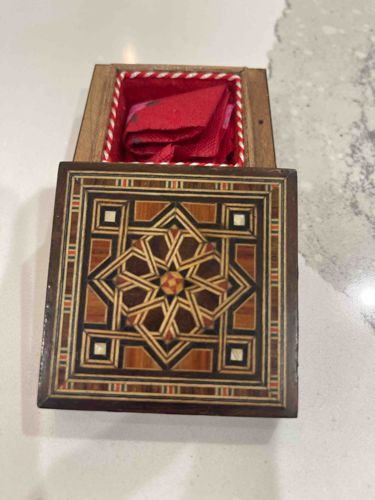
This is a rectangular wooden box, likely a trinket or jewelry box, exquisitely adorned with geometric marquetry, characteristic of Syrian craftsmanship, specifically from Damascus. The box features an intricate mosaic pattern, primarily composed of various shades of wood veneers including lighter natural wood tones, dark brown, and reddish-brown, along with lighter inlays that appear to be bone or mother-of-pearl, and subtle accents of red and black. The lid showcases a central starburst motif, an eight-pointed star, surrounded by complex interlocking geometric shapes derived from Islamic art principles. The precision of the inlay suggests a high level of artisanal skill, where individual pieces are cut and fitted together seamlessly to form the overall design. The exterior edges of the box and lid also display linear bands of striped and dotted patterns, adding to its visual richness. The interior of the box is lined with a vibrant red fabric, possibly velvet or satin, which is bordered by a decorative red and white twisted cord, suggesting a soft surface for delicate contents. The visible condition shows some minor wear consistent with age and use, such as slight dulling of the wood's finish and potential minor abrasions on the corners, but overall, the marquetry appears intact with no significant lifting or missing pieces. The wood has developed a rich patina over time, enhancing its character. While no specific maker's marks are visible in the image, the style strongly indicates it is a historical or modern production from Damascus, known for its expertise in this specific type of intricate woodwork. The age is estimated to be late 19th to mid-20th century, given the traditional design and construction methods.
AI Appraisal Report
Based on my examination of the provided image and the owner's description, this Damascene Marquetry Wooden Box is a fine example of Syrian craftsmanship. The intricate geometric patterns, particularly the central eight-pointed starburst motif, are characteristic of Islamic art and the renowned marquetry tradition of Damascus. The use of various wood veneers, bone/mother-of-pearl, and subtle color accents demonstrates a high level of artisanal skill and precision in the inlay work.
The condition appears good for its age, with minor wear consistent with use. I observe slight dulling of the wood's finish and potential minor abrasions, but crucially, the marquetry seems intact with no significant lifting or missing pieces. The rich patina adds to its character. The vibrant red fabric lining and twisted cord border within suggest careful preservation.
In terms of market conditions, demand for such oriental decorative arts, especially authentic Damascene pieces, remains steady among collectors of Middle Eastern artifacts and those who appreciate intricate craftsmanship. While not exceptionally rare, pieces of this quality and condition are sought after. Comparables typically range based on size, complexity of design, and condition.
Factors impacting value positively include the intricate craftsmanship and historical design. The primary limitation to a definitive appraisal from an image alone is the inability to conduct a physical inspection. Without hands-on examination, I cannot fully verify the material composition (e.g., confirming bone vs. plastic), assess interior structural integrity, or detect subtle repairs/restorations. A physical examination would allow for closer inspection of the inlay tolerances, assessment of the wood's condition for cracking or warping, and confirmation of age through wood grain analysis or tool marks. Provenance documentation, if available, would further authenticate its origin and history. Given these considerations, my appraisal is based on the visual evidence and descriptive details provided.