AI estimate as of August 4, 2025 · verify with a professional before acting
AI-Generated · Verify before acting
Everything on this page is generated by AI for informational purposes only. AI can make mistakes — the AI may misidentify items or misattribute them (artist, maker, brand, designer, origin, era). This is not an official valuation and should not be used for insurance, sale, tax, estate, legal, or lending purposes — or any decision requiring a certified appraisal. It is not an authoritative claim about any person, brand, or rights holder — do not share or rely on it as a factual statement about a third party. Always consult qualified professionals before making financial decisions.
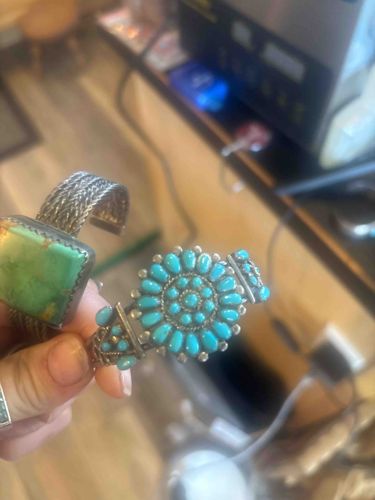
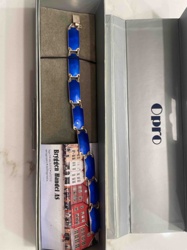
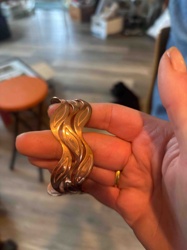
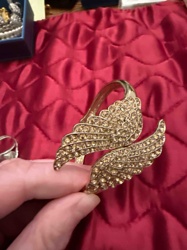
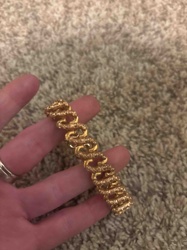
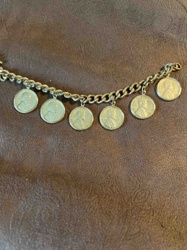
The item depicted is a silver cuff bracelet, likely of Native American (Southwestern) origin, featuring a prominent cluster of natural turquoise stones. The bracelet is of a traditional form, characterized by a central ornamental setting. The design is dominated by numerous small, teardrop-shaped turquoise cabochons, meticulously arranged in concentric circles around a central, slightly larger turquoise stone. This radial pattern with escalating layers of stones is commonly referred to as a 'cluster' or 'petit point' design, indicating the careful hand-setting of each individual stone. The turquoise exhibits a vibrant robin's egg blue color, with minimal to no visible matrix, suggesting a high-quality grade of stone. Each turquoise stone is set within its own individual silver bezel, indicating careful craftsmanship. Between the stones, tiny silver beads or 'drops' are visible, adding textural detail. The cuff itself appears to be constructed from sterling silver, judging by the typical appearance of oxidized silver from this period – it shows a darkened patina within the recesses, highlighting the raised silverwork. The construction of the cuff portion appears solid, with some visible detailing on the band sections flanking the central design. While specific maker's marks or signatures are not discernible from the image, the style strongly suggests a mid-20th century to contemporary Southwestern artistic tradition. The item appears to be in good overall condition, with the natural patination indicative of age and wear. No overt damage to the stones or settings is immediately evident, suggesting durable craftsmanship.
AI Appraisal Report
Based on my visual examination of the provided image, this Southwestern Turquoise Cluster Cuff Bracelet presents as an authentic piece of Native American jewelry, likely from the Zuni tradition, dating from the mid-20th century. The 'petit point' or cluster design, with individually bezel-set, tear-drop shaped turquoise cabochons meticulously arranged around a central stone, is characteristic of this style. The robin's egg blue turquoise, appearing largely free of matrix, suggests a higher grade of stone, which positively impacts value. The presence of tiny silver beads between stones adds a fine detail indicative of quality craftsmanship. The silver exhibits a natural patina consistent with age, and the overall condition appears good, with no overt damage visible on the stones or settings. What I can confirm from the image is the craftsmanship and material quality.
Market conditions for vintage Southwestern turquoise jewelry remain robust, especially for well-executed cluster designs. Comparables for pieces of this quality and estimated age typically fall within the higher range. Demand for genuine, handcrafted Native American jewelry is consistently strong, driven by collectors and enthusiasts alike. The rarity factor is moderate to high for pieces with such vibrant, clear turquoise and intricate cluster work. Factors significantly impacting value include the quality and saturation of the turquoise, the complexity and precision of the silverwork (individual bezels, applied silver drops), and the overall condition. The lack of visible matrix in the turquoise further enhances its appeal and value.
However, it is crucial to state the limitations of this appraisal. Without physical inspection, I cannot verify the exact metal purity (e.g., sterling silver content), confirm the stability of all stone settings, or definitively rule out any hairline fractures not visible in the photograph. Full authentication and a more precise valuation would require in-person examination to assess weight, internal stone integrity, and microscopic analysis for potential repairs or enhancements. Provenance documentation (e.g., original sales receipts, artist information) would further solidify authenticity and could potentially enhance value, though not essential for an item of this style. Scientific testing could verify turquoise origin if needed for a higher-level appraisal.